
Quick answer
Why does my dog dig holes in the backyard?
Heat, boredom, something interesting in the ground, and the fence line cover most of it. In a Las Vegas yard the heat reason dominates for a large part of the year, because soil a few inches down is cooler than anything above it. Look at the spot the dog keeps choosing, because the location usually explains the behaviour better than the dog does.
Why is my dog digging in the yard is a question with a much more local answer than most owners expect. In a climate like this one, digging is frequently a heat strategy before it is anything else, and treating it as a discipline problem when it is actually a temperature problem gets you nowhere.
This post is about reading the behaviour and about what the holes do to a desert yard. It is not training advice and I am not going to recommend a method, a device or anything you put in a hole. The health side of disturbed soil and dust has its own post and I will point you at it rather than paraphrasing it.
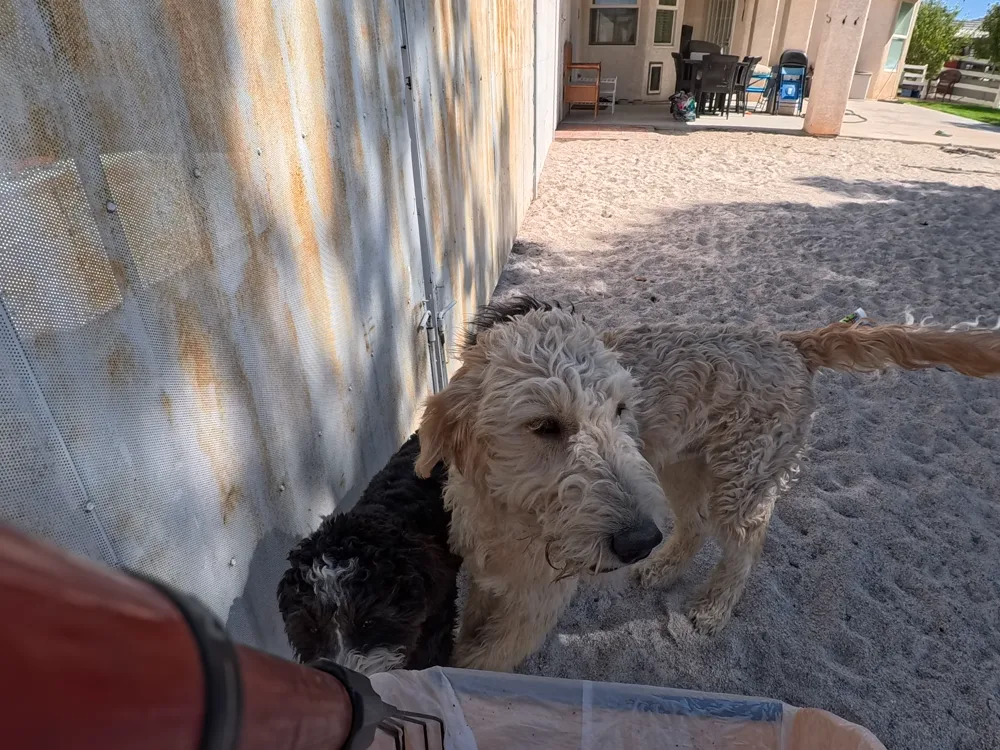
The reasons that show up most in a desert yard
Four explanations cover the large majority of digging in this valley, and they leave different evidence.
- Heat. Shallow, wide holes in shaded spots, and the dog lies down in them. Most common from late spring through early fall.
- Boredom and energy. Scattered, less deliberate, often along with chewing, barking or fence running.
- Something in the ground. Focused, repeated, always the same spot, often near irrigation, a wall, or a place something is buried or nesting.
- The fence or wall line. Digging along the base, usually toward something, whether that is a dog next door or a way out.
The useful move is to look at where and when rather than at the dog. Holes in shade in July mean something different from holes along the wall at eight at night.
Digging for cool ground in summer
This is the one to consider first here, because it is the one people miss.
Surfaces in a Vegas backyard get punishing in summer. Rock holds heat, concrete holds more, artificial turf can be hotter than either in direct sun. Soil a few inches down is cooler than all of it. A dog that scrapes out a shallow depression in a shaded bed and lies in it has solved a real problem with the only tool available.
Correcting that behaviour without fixing the underlying situation is unfair and it does not last. What changes it is giving the dog a better option: genuine shade over a surface that is not baking, water that is available and not sitting in the sun, and a spot indoors during the worst hours if that is possible for your household. Ideas for making a desert yard workable for a dog are collected in the post on dog friendly backyard ideas for Las Vegas.
Boredom, energy, and the fence line
A yard is not an activity. Dogs left alone in one for long stretches will find something to do, and digging is high on the list.
Fence line digging is its own thing and it is worth separating out. A dog working along the base of a block wall is usually reacting to something on the other side, whether that is another dog, movement in an alley, or a gap that lets a smell through. That is also the version with the highest stakes, because a dog that gets under a wall is a dog in the street.
What helps is a mix of more to do, more time with people, and less access to the trigger. What I am not going to hand you is a training protocol. If the fence line is the problem and it is not improving, a qualified trainer is worth the money, and they will want to see the yard rather than hear it described.
When they are digging at something in the ground
Repeated digging in one exact spot usually means the spot is the point.
Common causes in this valley:
- Irrigation. Damp soil around an emitter, or a small leak, is both cooler and more interesting. Once a dog finds it, tubing is easy for them to reach. That whole problem, including what a chewed line does to your water bill and to the plant it was feeding, is covered in the post on dogs and drip irrigation in a Las Vegas yard.
- Something living under there. Rodents and insects under a wall, a shed or a slab.
- Smell in the soil. Including old waste that was left long enough to work into the ground, which is one more argument for keeping the yard cleared rather than letting it ride.
- Buried organic material. Anything from a bone to whatever a previous owner left behind.
If digging turns into eating what comes up, that is a call to your veterinarian rather than a yard question.
What holes do to rock, turf, and drip lines
Digging is a landscaping problem as much as a behaviour one, and the repair bill is not always small.
Rock and decomposed granite
Digging mixes the ground cover with the soil under it, which is exactly what the material was installed to prevent. Rock spreads, weed barrier gets torn, and the yard slowly loses the clean line it had. Refilling a hole with the same rock is a short term fix, and repeated digging in one area usually means that patch has to be redone.
Artificial turf
Turf fails at seams and edges. A dog that gets a nail under an edge has a project, and once the edge lifts the damage accelerates. Turf repair is specialist work and it is not cheap, which makes prevention worth more here than anywhere else in the yard. If you are still deciding what to put down, the trade offs are covered in the post on replacing grass with desert landscaping when you have a dog.
Drip lines
Most drip tubing in this valley runs at or just under the surface, which puts it inside a dog's reach the moment they start digging near a plant. Repair is an irrigation technician or landscaper job. It is not something I do and it is not something to improvise if you are not sure what you are looking at.
The dust side
Disturbed soil and dust have a health angle that belongs to a different post, and it is a real one in this valley. Read the guide to valley fever, digging and Las Vegas soil for that, and take anything about your dog's health to your vet.
What to change before you try to correct the dog
Change the conditions first. It is cheaper, it is faster, and it works more often than correction does.
- Shade and a cool place to lie down. Real shade, over a surface that is not radiating heat.
- Water that stays cool and available.
- Time out of the yard during the worst hours.
- More to do. Walks at the right time of day, work for the dog's brain, company.
- Less access to the trigger. Blocking the view or the route along a fence line, without building anything that hurts an animal.
- A cleared yard. Fewer smells in the ground, fewer reasons to investigate a specific corner.
That last one is the part I can help with. Yards across the Las Vegas valley get cleared on a fixed weekday, whole yard walked, waste bagged into your own bin on site, photo afterward. You can get a quote in about a minute.
When it is a trainer or a vet question
Bring in a professional when the digging is sudden, escalating, or paired with anything else that changed.
A vet is the right call if the behaviour appeared out of nowhere, if the dog seems uncomfortable, if there is any chance something was eaten, or if there is any injury from the digging itself. Older dogs whose habits change suddenly should be seen rather than managed.
A qualified trainer or behaviour professional is the right call for anxiety, escape attempts, and anything that has become a fixed routine you cannot interrupt. That is their trade and they will do more in one session than a blog post can. My part stops at the yard, and I would rather say so than pretend otherwise.
If the yard part is what you want handled, get a quote for regular cleanup. It takes about a minute and service runs Monday to Friday. Questions first? Call or text (725) 200-2028.
Want your exact monthly price for this yard? The quote form takes about 60 seconds.
Get my free quote