
Quick answer
Should you replace your grass with desert landscaping if you have a dog?
For most Las Vegas households the answer is yes, with one condition: plan where the dog will actually be. Conversions go wrong when the whole yard becomes hot rock and the dog is left with nowhere shaded or comfortable. Decide the dog area and the drainage at the design stage, not after the work is finished.
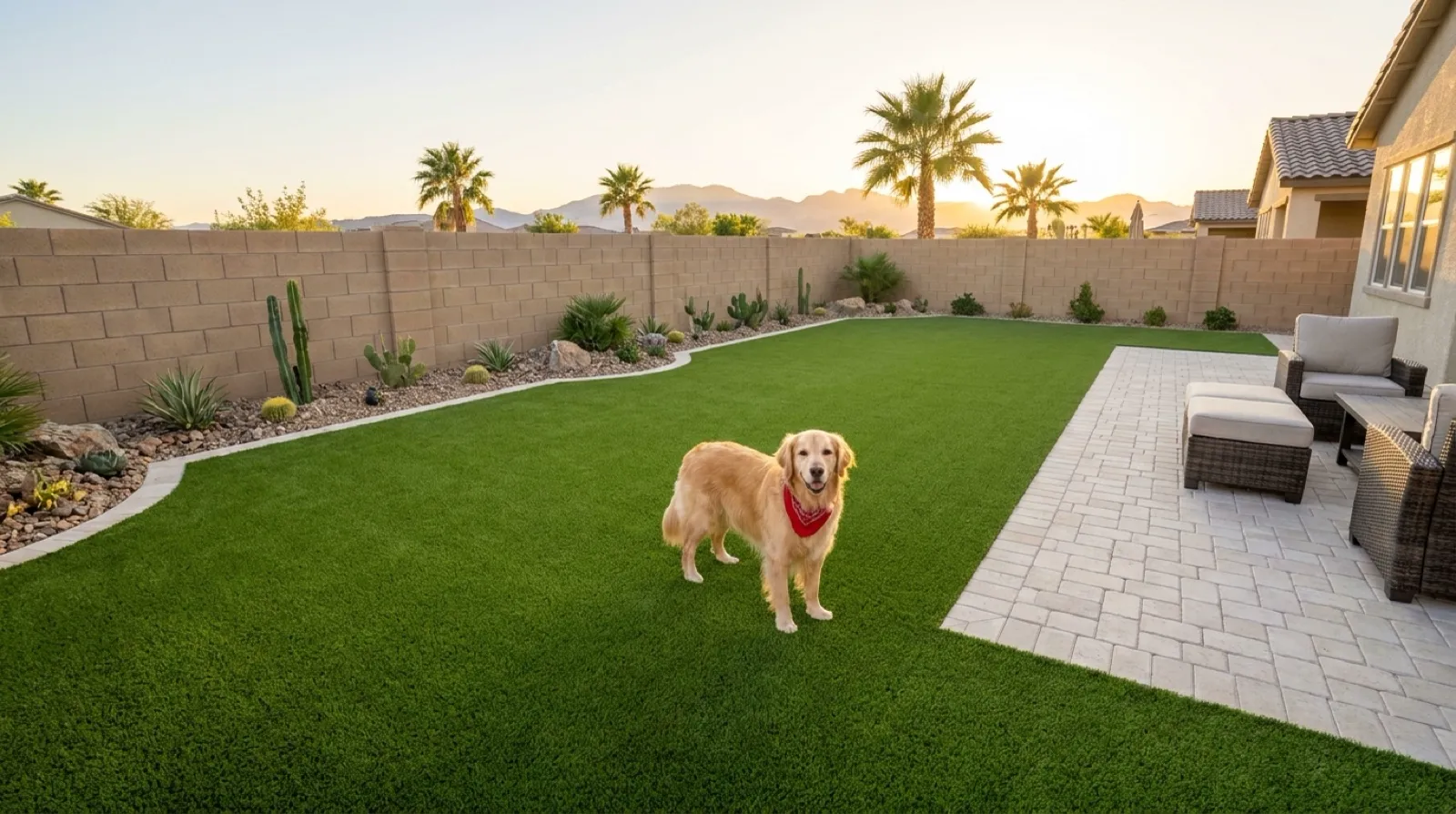
Replacing grass with desert landscaping when you have a dog is a project, and it is worth thinking about as one. This post is about the conversion itself: sequencing, what to keep for the dog, and what people wish they had done differently. If you are still choosing between materials, the gravel versus turf versus grass comparison is where that decision lives, and the ground cover post goes deep on the materials themselves. I clean yards. I do not do landscaping, and I am not going to recommend a contractor or a plant.
Why So Many Vegas Yards Are Losing Their Grass
Two forces, and they push the same direction.
The first is cost and effort. A real lawn in this climate wants water, mowing, fertilizing and seasonal attention, and it is the single most demanding thing in most Las Vegas yards.
The second is rules. Reading the Las Vegas Valley Water District's drought and conservation measures page on September 6, 2026, the district's service rules prohibit grass and spray irrigation in new development from April 5, 2022 onward, including new single-family homes, with schools, parks and cemeteries exempted. For single family homes built between 2003 and that date, grass is prohibited in front yards and limited in side and rear yards. The same page points at the water authority's Water Smart Landscapes program for homeowners replacing grass with desert-friendly landscaping. I am not printing an amount for that, because the terms belong to the water authority and they change.
Practically: check what applies to your address before you design anything, because the rules differ by when your home was built and by which provider serves you.
What Actually Changes for the Dog
This is the part that gets skipped, and it is the part the dog notices on day one.
Grass is cool, soft and comfortable to lie on. Rock is not. In summer a rock surface in direct sun is hot, and a dog that used to stretch out on the lawn now has nowhere it wants to be. Everything else follows from that.
Watch what the dog does today before anything gets torn out. Where does it lie down in the afternoon? Where does it go to the bathroom? What route does it walk when someone comes to the gate? Those three answers should shape the plan, because a dog does not adapt to a design. It keeps its habits and takes them out on whatever you put there.
Anything to do with paws, heat and your particular dog is a question for your vet, and so is any plant going into the ground. Online plant lists are not written for your dog.
What Changes for Whoever Cleans the Yard
Cleanup gets easier in some ways and harder in others, and it is worth knowing which is which before you commit.
Easier: no mowing to work around, no wet grass, no soft ground, nothing hiding behind blade height.
Harder: on decomposed granite, waste is genuinely difficult to see, because the color and texture match and there is no contrast in flat light. Soft waste works into the top layer of loose rock and cannot be lifted cleanly. And the perimeter, where rock meets the block wall, becomes the place everything collects.
The net effect is that a rock yard rewards frequency more than a lawn does. Clear it often and it is quick. Let it go a couple of weeks in summer and the job changes character, because now you are picking fragments out of gravel rather than lifting waste off a surface. That shift is the most common surprise after a conversion, and it is why plenty of households start a routine when the new yard goes in. The quote form takes about a minute.
Leaving a Spot the Dog Can Still Use
The best conversions I see keep a defined area for the dog rather than converting every square foot.
The options are all reasonable. A patch of artificial turf in a shaded part of the yard gives the dog something soft to stand on, though it has its own maintenance story and there is a separate post on turf drainage and dog urine worth reading first. A dedicated gravel relief area, sited where the dog already goes, concentrates the mess and spares the rest of the yard. Shade over any of it decides whether the dog uses it in July.
The failure mode is a beautiful yard the dog refuses to walk on, so it holds until it cannot and goes wherever it is standing, usually the patio. That is a design problem, not a training problem.
Surface Choices, and Where Dogs Are Hardest on Each
Since the choice itself is covered elsewhere, here is only the dog angle on each.
Decomposed granite
The valley default. Comfortable underfoot, cheap to cover ground with, and the hardest surface here to spot waste on. A dog that digs a hollow to lie in is looking for cooler ground.
Larger rock and river rock
Easier to see waste against, harder to walk on for both of you, and it swallows anything that gets between the stones. Small waste falling into the gaps is a real problem in a dog area.
Artificial turf
The most dog-friendly surface here and the one with the longest maintenance tail. It handles traffic, it looks green, and it needs solids removed promptly because liquid goes into the infill rather than through it.
Pavers and concrete
Easiest to clean, hottest in the sun. Good for the areas people use, poor as a dog's only surface.
Drainage, Odor, and the Mistake That Shows Up a Year Later
Grass absorbs a lot of water. When it comes out, that water goes somewhere else, and if nobody planned for it the yard will tell you later.
The version I see is a low area, often against the house or a wall, that stays damp longer than everything around it. In a dog yard that low area becomes the odor complaint, because residue collects where water collects. It shows up months later, when nobody connects it to the landscaping any more.
So ask about grading before the work starts, and ask where water goes in a hard rain. Ask the same about the irrigation that used to serve the lawn, because emitters and lines left live under new rock make a permanent wet patch nobody can find. And read the post on hosing a yard and the local water rules, because the instinct to wash down a new rock yard is the one the rules restrict.
One last piece of sequencing. Clear the yard completely before demolition starts. Anything left in a lawn that is about to be scraped, graded and covered ends up buried under the finished landscaping. Booking a full clearing before the landscaper's first day is a normal service request and the cheapest insurance in the project.
Converting the yard and want it cleared properly before the work starts, or kept clear once the new surface is in? Tell me how many dogs, how big the yard is, and how often you want service, and the quote form gives you a number in about a minute. Service runs Monday through Friday and every visit ends with photos. Questions first, call or text (725) 200-2028.
Get my free quoteCommon Questions About Converting a Lawn With a Dog
Should I replace my grass with desert landscaping if I have a dog?
Usually yes, as long as you plan the dog a shaded, usable spot rather than converting every square foot to hot rock.
Is desert landscaping bad for dogs?
Different rather than bad. The real issue is heat and comfort, so shade and an alternative surface matter. Ask your vet about paws and about any plant.
Is it easier to clean up dog poop on rock or grass?
Easier on rock when it is firm, harder when it is not. Decomposed granite hides waste visually and holds anything soft in the top layer.
Can I get a rebate for removing grass in Las Vegas?
The water district points at the water authority's Water Smart Landscapes program. Confirm the current terms with the water authority, not with a blog post.
What is the biggest mistake in a conversion with a dog?
Ignoring drainage and leaving the dog nowhere to be. The first shows up a year later as a damp low spot, the second shows up immediately.
Want your exact monthly price for this yard? The quote form takes about 60 seconds.
Get my free quote