Quick answer
How often should a doggy daycare play yard be cleaned?
More often than a residential yard, weighted toward your busiest days rather than spread evenly across the week. Immediate pickups during a session stay in house, because they have to happen in the moment. A scheduled Las Vegas visit covers the deeper clear, the fence line, drains, shaded corners, and a sanitizing pass.
Doggy daycare pet waste removal in Las Vegas is a different job from residential scooping, and if you run a daycare or a boarding facility you already know why. A backyard gets one or two dogs. Your play yard gets a rotating group all day, on surfaces built for traffic, in a building where the first thing a client notices at drop off is the smell.
This post is written for the owner or the manager. Here is what a play yard actually needs and how a scheduled service fits around what your staff is already doing.
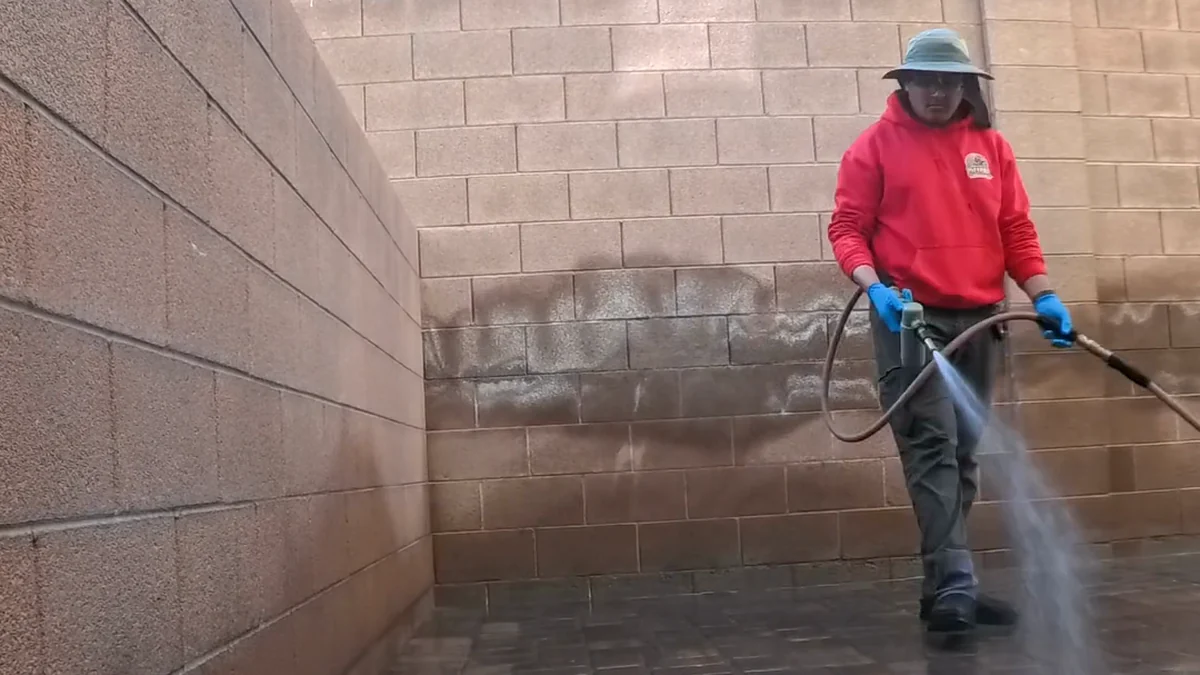
Why a play yard is a different job than a backyard
Three differences drive everything else.
Volume and turnover. A residential yard has a predictable load from the same dogs every day. A play yard has a different population every session, dogs that are excited, dogs that are stressed, dogs on unfamiliar food and water. Output is higher and less predictable, and it arrives in bursts around the times you are busiest.
The surface is engineered, not decorative. Sealed concrete, commercial turf, K9 grade artificial grass, gravel runs, rubber matting. These are chosen for durability and drainage rather than looks, and each one holds material differently from a homeowner's backyard.
It is a business asset. A homeowner with a smelly yard has an annoyance. A facility with a smelly yard has a review problem, a retention problem, and a staffing problem, because nobody enjoys working in it either.
All of that means the cleaning question is not really "is the yard picked up". It is "does the yard hold up on a busy Thursday afternoon in July".
Turnover, volume, and the between groups reset
The immediate pickups during a session are your staff's job and always will be. Someone has to be watching the dogs anyway, and material has to come up the moment it appears. Nobody outside the building can do that.
What gets squeezed is the deeper pass. The between groups reset, the corners, the perimeter along the fence line, under and behind the play structures, the drain area, the shaded strip where dogs congregate when it is hot. Those are the parts that get shortened first when the floor is busy, and they are exactly the parts that produce the smell three days later.
The honest business case is not that scooping is beneath your staff. It is that every hour someone spends on a deep clear is an hour they are not watching dogs, and watching dogs is the service you actually sell. Handing the scheduled deep pass to an outside service converts a recurring internal cost into a fixed line item and gives your people their attention back.
If you want a scheduled routine priced for your property, you can start a quote or read more on the commercial pet waste service page.
Surfaces built for traffic and what they hold
Commercial surfaces solve the durability problem and create a different one.
Commercial artificial turf
The dominant choice for play yards, and the one that misleads people most. Turf built for kennels drains well by design, which is genuinely good. What it does not do is remove residue. Solids come off the blades easily and everything else works down into the infill and the drainage layer. The yard looks immaculate and smells worse every week. On turf, frequency of removal matters more than any single deep clean, because you are trying to take material out before it has time to go down.
Sealed and unsealed concrete
Sealed concrete is straightforward: material sits on top and comes off. Unsealed or worn concrete is porous, so odor stays in the slab after the mess is gone. That is not a scooping problem, it is a surface problem, and it is the most common reason a facility says the yard is clean but the smell is still there.
Gravel and decomposed granite runs
Common in boarding kennel runs because they drain and stay cooler than hard surfaces. They are also the hardest to clear well, because material dries, breaks apart, and drops between the stones. Rinsing pushes it down rather than out. These runs need careful removal and they need it more often than you would expect from their size.
Drains, low spots, and the shaded corner
Wherever the yard drains, that is where residue accumulates. Wherever the shade is, that is where the dogs pile up when it is hot and where the ground stays damp. Both need to be on the checklist by name, because both get walked past.
Odor is what clients notice at drop off
Worth saying plainly: for a daycare, odor is a sales problem before it is a hygiene problem.
A client walking in for a tour is making a judgment in the first ten seconds, and they are making it with their nose. They are not evaluating your protocols, your staffing ratio or your play group management. They are deciding whether this place smells like a business that has it handled. Existing clients do the same thing every morning at drop off, less consciously, and it feeds directly into whether they book the next block.
The source is usually not what people assume. It is rarely a pile someone missed. It is residue in turf infill, odor held in porous concrete, and a damp corner that never dries. Those need removal plus a surface level treatment, which is what sanitizing and deodorizing addresses: residue and odor on the surface, after the waste itself has been taken out. It is not a medical procedure, it does not replace anything your own policies or your veterinarian require, and any facility telling you a treatment does more than that is overselling it.
Removal first, always. Sanitizing on top of waste that is still there accomplishes nothing.
Sanitizing and scheduling around your busiest days
The scheduling principle is simple: put the service where the load is, not evenly across the calendar.
Most Las Vegas facilities have a rhythm. Monday tends to be heavy. The back half of the week fills up. Holiday periods spike boarding rather than daycare. Summer changes everything because heat concentrates the dogs into the shaded parts of the yard and speeds up how fast odor develops. A schedule that ignores that rhythm either underserves the busy days or overserves the quiet ones.
What tends to work:
- Service weighted to the heavy days rather than spread evenly.
- Timing set around your operating hours, so the visit lands when the yard is available rather than when a group is in it.
- A sanitizing pass on a set interval rather than only when someone notices a smell, because by then it has been building for a while.
- A seasonal step up for summer, agreed in advance rather than negotiated in the middle of a July heat run.
Two practical notes. Service days are Monday to Friday, so anything you need covered outside those days stays with your staff and should be planned for rather than assumed. And waste goes into your own commercial bins on site, bagged. Nothing is carried off the property.
If your facility also has a small client facing relief strip out front, that area has its own set of problems and is covered separately in the post on pet relief area cleaning for Las Vegas clinics and grooming shops.
Common questions from facility owners
Do you work with daycares and boarding facilities?
Yes. Play yards, kennel runs and outdoor potty areas are quoted per property, Monday to Friday.
Does this replace my staff's pickups?
No. Immediate pickups stay in house because they have to happen in the moment. This handles the scheduled deep clear and the sanitizing pass.
How often should a play yard be serviced?
More than a residential yard, weighted toward your busiest days. It depends on dog volume, how many separate yards you run, and your surfaces.
What does sanitizing do?
It addresses residue and odor on the surface after removal. It is not a medical procedure and does not replace your own protocols.
Where does the waste end up?
In your own bins on site, bagged. Nothing leaves the property.
Getting a proposal for your facility
Every facility is different enough that a quote should start with the actual property: how many yards, what surfaces, how many dogs on a heavy day, and what your staff is already covering.
Start a quote for your facility, or read the commercial service page for how recurring commercial work is set up. Prefer to talk it through? Call or text (725) 200-2028.
Two related reads on the sanitizing side: why Las Vegas yards need sanitizing more than most explains what the treatment addresses, and do dog waste stations work is worth a look if you also have an outdoor area clients use unsupervised.
One person boarding dogs in their own backyard has the same problem at a very different scale, and the home boarding guide is written for that reader.
Want your exact monthly price for this yard? The quote form takes about 60 seconds.
Get my free quote