
Quick answer
Can I get pet waste removal at multiple rental properties?
Put each address on its own route day, with its own gate notes, and every visit produces photos of the finished yard and the latched gate. For a Las Vegas rental you rarely stand in, that dated record beats anybody's memory at turnover. Schedules can be paused between tenants, and a move out clearing can be booked before listing photos.
Rental property pet waste removal in Las Vegas is a different conversation than the one homeowners have, so let me scope this post before you read further. If you are a tenant wondering whose job the yard is, the post on renters and dog waste in Las Vegas is written for you. If you run a short term rental, the short term rental pet waste post covers that. This one is for owners and property managers with long term single family rentals, where the yard is an asset you rarely stand in and the cost shows up at turnover.
Where Pet Waste Actually Costs a Rental Owner
It is almost never a line item called pet waste. It shows up disguised as other things.
- Turnover days. A yard that needs work is a property that is not photographed, not listed, and not showing. Days of vacancy are the real number and nobody puts them on the invoice.
- Landscape damage. Dead patches in grass, turf that has gone sour in one corner, and ground that has been used hard for a year without anybody clearing it.
- Deposit disputes. The least fun conversation in the business, and one that goes better when there is a documented condition record instead of two people remembering differently.
- Neighbor and association complaints. These land on the owner or the manager, not the tenant, and they take time to answer.
- Showings that go quiet. Prospective tenants walk into a backyard, smell it, and go politely non committal. Nobody tells you that is why.
Every one of those is a cost that is difficult to attribute, which is exactly why the underlying cause gets ignored for years.
Pet Rent, Pet Deposits, and What They Do Not Cover
Most Las Vegas rentals that allow dogs collect something for the privilege, whether that is a deposit, a fee, monthly pet rent, or some combination. That is a reasonable arrangement and I am not here to argue with it.
What is worth noticing is what those charges are actually doing. They are a buffer against damage, collected at the start, applied at the end. They are not a maintenance program. Nothing about collecting pet rent changes the condition of the yard during the tenancy, and by the time you are reaching for a deposit you have already absorbed the vacancy and the repair scheduling.
The alternative framing is boring and it works better: treat the yard the same way you treat landscaping. Something happens on a schedule, at a known cost, and the property does not accumulate a problem. I am not giving you legal advice about lease structure, and what a given clause can or cannot require is a question for your attorney. I am pointing out that maintenance during a tenancy and recovery after one are two very different financial events.
Turnover, Listing Photos, and the Yard a Tenant Left
Turnover is where this gets expensive fast, and the sequence is always the same. Tenant leaves. Someone walks the property. The yard is worse than expected. Now the photographer is rescheduled, the listing slips, and the backyard picture that goes up is the one where you cropped tight to avoid showing the ground.
A backyard photograph carries a lot of weight in a listing here, because in Las Vegas the yard is a selling point. Anyone with a dog is looking straight at it, and they are the people most likely to pay a premium for a house that allows one.
The practical fix is a clearing booked before the photos rather than after the complaints. If you know a move out date, book it a few days ahead. Service runs Monday through Friday, and turnover timelines rarely leave much room, so the difference between a scheduled clearing and a scramble is usually just a bit of notice.
Yards You Never See in Person
This is the part of the job that matters most to somebody managing addresses across the valley, and it is why photo proof leads this pitch instead of being a footnote.
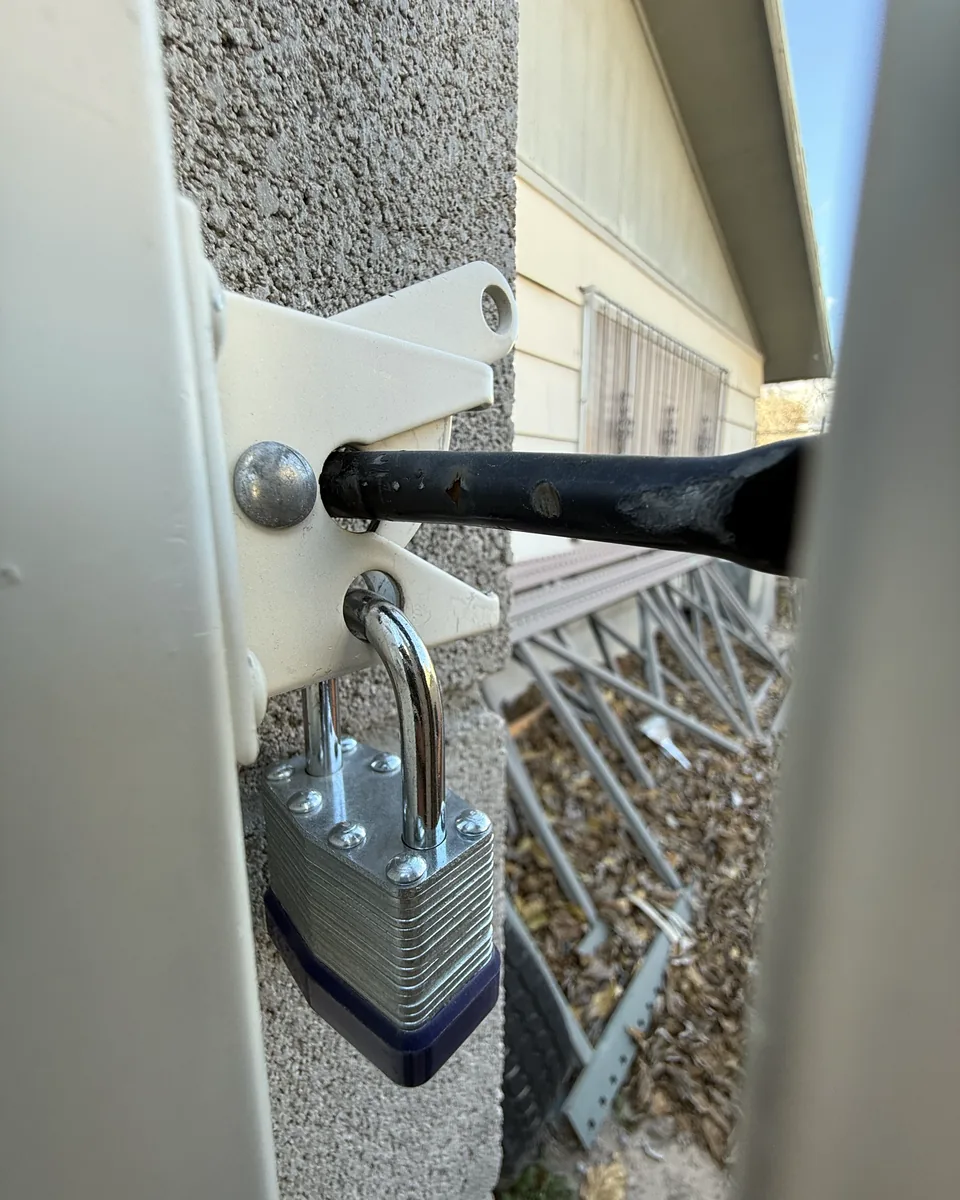
Every visit produces pictures of the finished yard and a picture of the latched gate. For an owner in another state or a manager with a portfolio, that is a running visual record of the condition of a property nobody has walked in months. You can see whether the grass is holding up. You can see the yard was actually accessible. You can see the gate was closed behind me, which is a small thing right up until a dog gets out.
It also settles the question that comes up in every disputed turnover, which is what the yard looked like over time rather than on the last day. A dated set of photos is a better answer than anybody's memory.
If you want pricing for one property or several, the quote form prices each address on how many dogs are there, how big the yard is, and how often you want service.
Lease Language Versus Handling It Yourself
There are two models and both are legitimate.
You can make it the tenant's responsibility and write it into the tenancy. That costs you nothing directly. The catch is enforcement, which means inspections, notices, and a conversation nobody enjoys, and the condition of the yard still depends entirely on somebody else's follow through. Whether a clause is enforceable and how is a question for your attorney, not for me.
Or you can handle it as an owner cost, the same way many owners already handle front yard landscaping, and price it into the tenancy. That costs money every month and removes the enforcement problem entirely, because the outcome no longer depends on anybody remembering.
There is a middle version that works well: the owner sets up the service and the tenant is told it happens on a given day so the gate is clear and the dog is inside. It gets the reliability without making the tenant the one responsible for arranging it.
Setting Up Service Across Multiple Addresses
Practically, here is how a portfolio gets handled. Each property is its own account with its own notes: gate location, lock or code, whether there is a dog out, which side the bins live on, and any gated community access. Route days get set per address. Billing can sit with the owner, the management company, or the tenant, whichever fits how you already operate.
A few things that make it run smoothly. Tell me at signup if a property is between tenants, because a vacant yard and an occupied one need different frequencies. Tell me when a tenant changes so the notes get updated instead of me finding out at a locked gate. And if a property needs a one time clearing rather than a schedule, say so, that is a normal request.
For communities, HOA common areas, and larger properties, the commercial and HOA service page covers how that side works. Single family rentals sit somewhere between residential and commercial, and they get handled with the residential routine and commercial style reporting.
Poop Scoop Dude® is locally owned, and the person who sets up your account stays accountable for it. There are no contracts, which matters in rentals where a property can be occupied, empty, and occupied again inside a year.
Want your rental yards handled and documented instead of discovered at turnover? Tell me the addresses, how many dogs are there, and how often you want service, and the quote form prices it in about a minute. Service runs Monday through Friday with photos after every visit. For a portfolio, call or text (725) 200-2028 and we will set the properties up together.
Get my free quoteCommon Questions From Owners and Property Managers
Can you service multiple addresses?
Yes. Each property gets its own access notes and route day, and every visit produces photos.
Who usually pays, owner or tenant?
Both arrangements happen. What matters is that one person clearly owns the account so nothing falls between parties.
Do you do move-out cleanups?
Yes, a one time clearing before photos or a walkthrough is a common booking. Give a few days of notice where you can.
How do I verify a visit at a property I never see?
Photos of the finished yard and the latched gate after every visit, dated.
Is there a contract?
No. Schedules can be added, paused between tenants, or stopped.
Want your exact monthly price for this yard? The quote form takes about 60 seconds.
Get my free quote