Quick answer
Why does my artificial turf still smell after scooping?
The odor sits below the blades, in the infill and the base, where a scoop cannot reach. In a Las Vegas turf yard the infill packs down hardest along the path the dog uses, so liquid stops draining and one area holds damp. Rinsing that no longer helps is a drainage signal, not a cleaning one.
Artificial turf drainage and dog urine is the subject nobody covers, because it lives underneath the two topics everybody does cover. Let me draw the lines up front so you are in the right place. If your question is about waste sitting on top of turf, read the post on dog poop on artificial turf. If it is about urine odor in a yard generally, read dog urine smell in a Las Vegas yard. This post is about what happens below the blades: infill, the drainage layer, and compaction. That is where a turf yard that keeps smelling is usually failing.
What Is Actually Under Artificial Turf
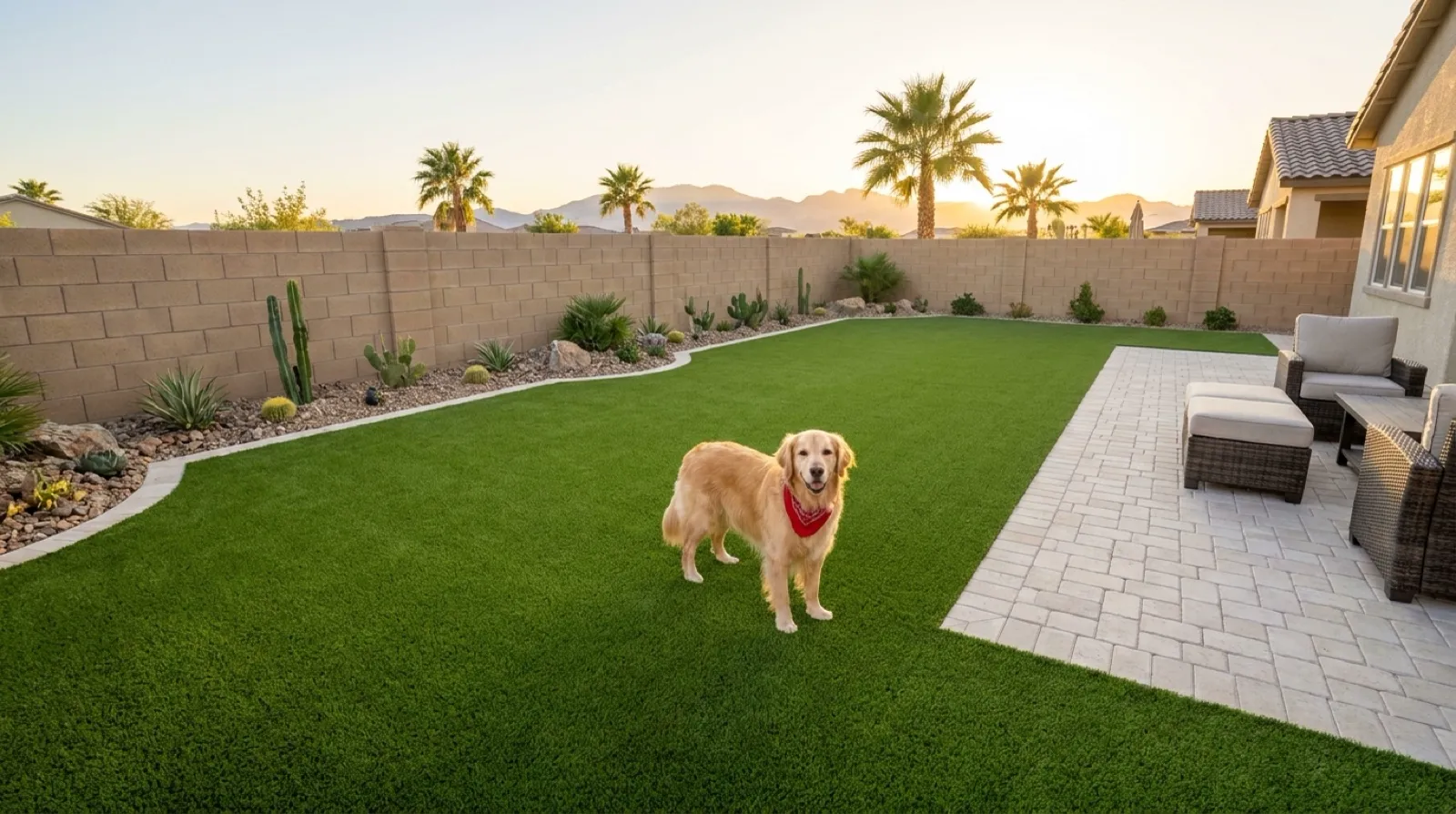
Most homeowners have never seen their turf installed and picture it as a carpet laid on dirt. It is more of a system, and each layer has a job.
- The base. Compacted aggregate, graded so water moves and does not pool. This is the layer everything else depends on.
- The turf backing. Perforated with drainage holes so liquid can pass through rather than sit on the surface.
- The infill. Granular material brushed down between the blades. It weighs the turf down, keeps the blades standing up, and gives the surface its feel underfoot.
When it all works, liquid goes down through the infill, through the holes, into the base, and away. When it does not, it stays somewhere in the middle. That is the entire subject of this post, and it explains almost every case of a homeowner who scoops diligently and still opens the back door to a smell in August.
Infill Types and How Each Handles a Dog
Infill is chosen at install time, usually by the installer, often without a conversation about the dog. It matters more than people realize.
Sand based infills are the common default. They are inexpensive and they do the mechanical job well. Rubber infills were popular for sports surfaces and have their own characteristics in heat. There are also infills marketed specifically for pet yards, sold on the basis that they manage moisture and odor better than plain sand.
I am going to be careful here, because this is exactly where turf marketing outruns what anybody can promise. What is fair to say is that infills differ in how much moisture they hold, how they behave as they compact over time, and how easy they are to refresh. What is not fair to say is that any of them handles the problem on its own. None of them is a substitute for getting solids off the surface promptly, and none of them makes the drainage layer underneath irrelevant.
If you do not know what is in your yard, ask whoever installed it. That is their trade and they will know. It is a useful thing to have written down before you ever need service on it.
Where the Liquid Goes, and Where It Does Not
Three failure points, in the order I run into them.
Compaction. Infill settles and packs down over the years, and it packs down fastest where the traffic is. Dogs are creatures of habit, so one area gets used constantly while the rest of the yard barely gets walked on. Packed infill drains more slowly than loose infill. That is why the smell is almost always concentrated in one region of the turf instead of spread evenly.
Low spots. Bases settle unevenly. A dip that holds a puddle for an hour after a rinse is a dip that stays damp underneath much longer than that. Find them by watching where water sits after you run a hose, not by looking at the dry surface.
Blocked drainage. Fine material, dust, and debris work down into the infill over the years and slow everything below it. In this valley there is a lot of fine dust in the air, so this is not an unusual outcome, it is the normal aging process for turf.
Add the desert to all three. Liquid that reaches the base drains and evaporates. Liquid trapped in packed infill in a shaded corner does neither, and that spot becomes the source.
Why Rinsing Alone Stops Working
Almost everybody starts with a hose, and honestly, on newer turf with loose infill and good drainage, rinsing works fine. It dilutes what is near the surface and the base takes it away.
The moment it stops working is the moment worth paying attention to. If a rinse used to help and now the smell comes back within a day, that is not a sign you need to rinse harder or more often. It is a sign the water is no longer going where it used to go. Adding more water to a layer that is not draining gives you a damp, packed spot that smells worse than before, which is why some people find the yard is worse after they clean it.
That is the diagnostic. Rinsing that has stopped helping is a drainage message, not a cleaning message.
Keeping the solids off is the part that is fully in your control, and it is the part that stops the problem compounding. If you would rather not be doing it yourself, the quote form prices service on how many dogs you have, how big the yard is, and how often you want it.
What Sanitizing Addresses and What It Does Not
Sanitizing is worth explaining honestly because turf owners ask about it constantly.
What it does: it treats the surface and the residue that scooping cannot physically lift, which is the layer responsible for a lot of the day to day smell in a heavily used yard. In a walled Vegas backyard with turf and a dog that goes in the same three square feet, that residue builds up whether or not you are diligent, because it is not something a scoop can pick up. Applied after a proper clearing, on a schedule, it makes a real difference to how the yard smells. The deodorizing and sanitizing page explains how that add on works and what a visit looks like.
What it does not do: it does not repair a compacted infill layer, it does not re-level a settled base, and it is not a permanent fix applied once. Anybody telling you a single treatment permanently solves a turf odor problem is selling you something. If the drainage under your turf has failed, the treatment is riding on top of a mechanical problem.
When Turf Needs a Professional Refresh
Sometimes the answer is not more cleaning, it is turf work. A turf installer can power broom the surface to lift matted blades, top up or replace compacted infill, and in the worse cases lift a section to correct a base that has settled or a drainage layer that has silted up. That is their trade, not mine, and it is the right call when the problem is structural.
The signs that you are in that territory: odor that is worse in one defined area every year, a spot that stays visibly damp long after the rest is dry, infill that has clearly gone from loose to packed underfoot, or blades that lie flat and will not stand back up in the traffic lane.
Turf is a long lived surface and none of this means it was a bad choice. It means it is a system with maintenance, the same as anything else, and getting the layer under the blades attended to occasionally is part of owning it.
Want the solids handled every week so the layer underneath stops getting worse, with sanitizing as an option on top? Tell me how many dogs, how big the yard is, and how often you want service, and the quote form gives you a number in about a minute. Service runs Monday through Friday, with photos after every visit. Questions, call or text (725) 200-2028.
Get my free quoteCommon Questions About Turf, Drainage, and Urine
Why does my turf smell even though I scoop?
The odor is coming from under the blades. Liquid moves into the infill and the base, which is not a layer a scoop reaches.
What is under artificial turf?
A compacted base for drainage, perforated turf backing, and infill brushed down between the blades. Odor problems are a failure in one of those layers.
Does infill type matter for dogs?
Yes. Infills differ in moisture handling and how they compact. Ask your turf installer what is in your yard.
Why did rinsing stop working?
Because the water is no longer draining away. That is a drainage message, not a reason to rinse more.
Will sanitizing fix it?
It addresses surface residue and helps a lot with day to day smell. It does not repair compacted infill or a settled base.
Want your exact monthly price for this yard? The quote form takes about 60 seconds.
Get my free quote