
Quick answer
Why does my dog only go in the side yard?
Shade, cooler ground, privacy, and an edge make the side strip the best spot on the lot from a dog's point of view. It is also the worst place for waste to sit, because a Las Vegas side yard gets no direct sun and almost no airflow, so nothing dries and nothing disperses. Remove the solids first rather than hosing.
Side yard dog poop is the most common hidden problem in a Las Vegas backyard, and almost nobody goes looking for it. The main yard gets picked up. The patio gets swept. The narrow walled strip along the side of the house, the one you walk through twice a year to get to the shutoff valve, quietly becomes the dog's favorite place to go.
Then one afternoon you open the bedroom window on that side of the house and find out.
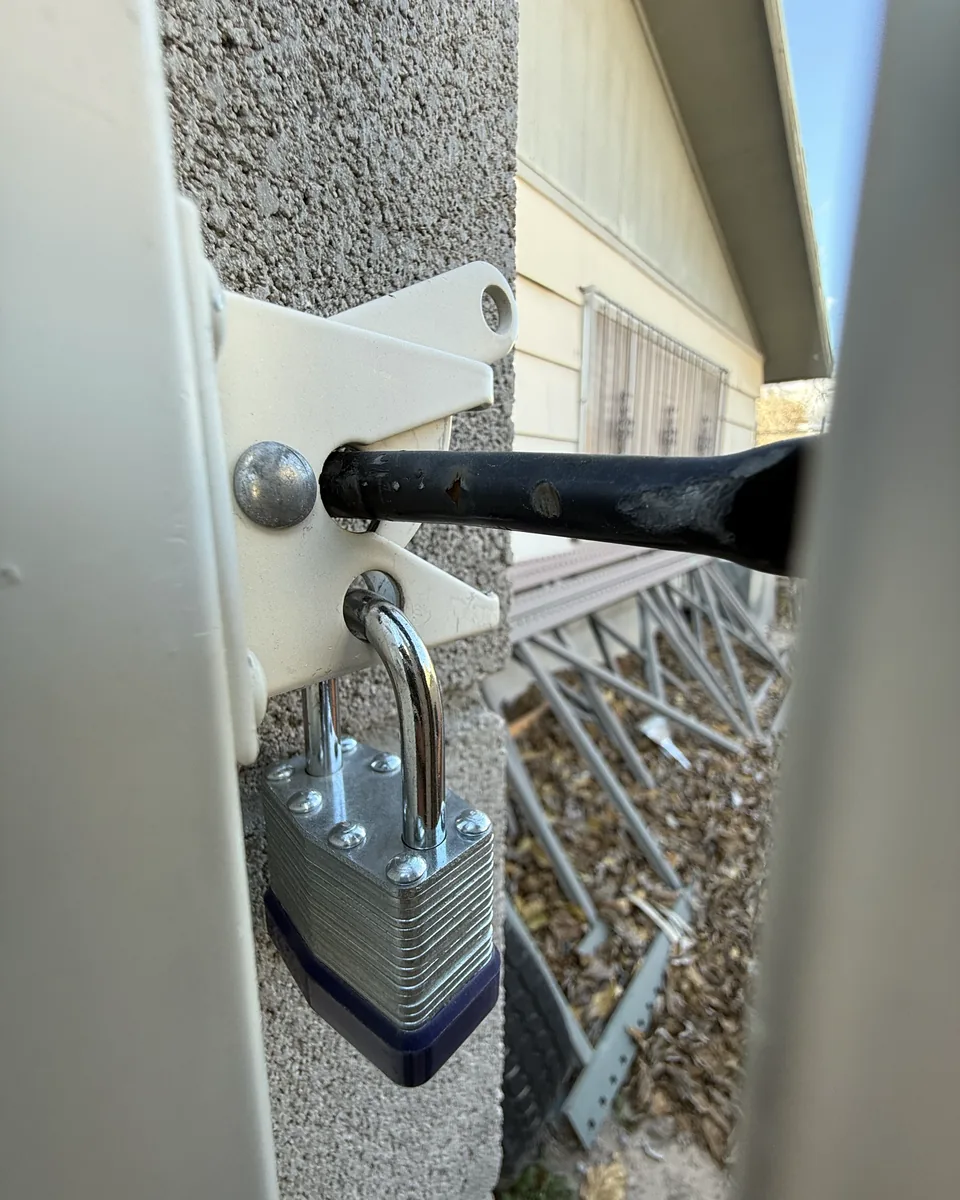
Why the side yard becomes the default spot
Dogs are not being difficult. They are picking the most sensible place available.
Look at what the side yard offers a dog here. It is shaded most of the day, because the house blocks the sun from one side and a block wall blocks it from the other. That makes it noticeably cooler than the open yard, which in Las Vegas is a real preference. It is narrow, which reads as enclosed and private. It is out of sight of the back door, so nobody is watching. And it is at the edge of the property, and dogs prefer edges to the middle of an open space.
Put those together and the side yard is the best spot on the lot from the dog's point of view. In a lot of Vegas tract homes it becomes the primary spot within a few months, and the owner never notices the switch because they never go back there.
No sun, no airflow, all odor
The same features that make the side yard attractive to a dog make it the worst place on the property for waste to sit. An open Vegas backyard gets brutal sun and moving air, so whatever is left there dries out fast and the smell disperses. A side yard gets neither. Two walls a few feet apart, shade most of the day, and effectively no breeze. Material breaks down slowly, moisture hangs around, and the odor goes up, along the wall, and in through whatever windows are on that side of the house.
That is why so many people describe the problem as "the house smells like dog but the yard looks fine". The yard does look fine. The strip beside it is not, and it is the strip closest to the bedrooms. If you are still working out where a smell is coming from, the guide to diagnosing backyard dog poop smell in Las Vegas walks through the full list of suspects.
Gravel strips, drains, and the air conditioning unit
Three things are almost always in a Vegas side yard, and all three make cleanup harder.
Gravel over dirt
The side yard is where builders put the cheapest ground cover, usually a thin layer of rock over compacted dirt or over weed fabric. Waste dries on top, breaks apart, and drops between the stones. Raking spreads it. Hosing washes it down into the fabric and the soil, where it stays damp in a place that never dries. Removal has to be careful and it has to happen before things break down, because after that the material is in the gravel rather than on it.
The drainage path
Most tract lots drain along the side yard toward the front. That means the side strip is the low route for everything moving off the back yard. It is also where the downspouts often let out. So the side yard collects, and the corner where it meets the front gate collects most of all.
The air conditioning unit
The condenser is usually on the side of the house, and it does two unhelpful things. It occupies the narrowest part of an already narrow strip, so cleaning around it is awkward, and it drips condensate in the warm months, which keeps a patch of ground damp in the one part of the yard that should never be damp. Dogs go near it because there is shade and a cool surface. That combination is worth checking specifically.
Courtyard homes and enclosed patios
A lot of valley homes, especially older builds and smaller lots, have a front or interior courtyard, or a fully walled patio that functions as the entire yard.
Everything above applies, only more so. A courtyard is enclosed on more sides, so airflow is worse. It is usually all hard surface or hard surface plus a small planted bed, so there is nowhere for anything to go and the material sits on concrete or pavers. And it is often the space you actually use, right outside the living room, which means the odor problem and the living space are the same square footage.
Hard surfaces bring their own issue: concrete and open paver joints are porous, so odor stays in the surface after the mess itself is gone. Removing waste stops the problem getting worse. Getting the surface itself back is a separate job, which is what yard sanitizing and deodorizing is for. Small enclosed spaces are exactly where that difference is most obvious, because there is no open yard to dilute anything.
The small yard and patio version of this problem shows up a lot in the older central parts of the valley. The Paradise dog poop cleanup guide covers that neighborhood specifically if that is where you are.
If you want the strip handled on a set day rather than remembered occasionally, you can get a quote in about a minute.
Cleaning a strip you can barely walk down
Practical, since this is the part people give up on.
- Go in from both ends. Most side yards have a gate at each end. Working from one end to the middle and then the other end to the middle beats trying to back out of a dead end while carrying a bag.
- Remove first, water never. Solids come up before anything else happens. Do not start with a hose. In a shaded strip that does not dry, adding water is how a bad smell becomes a permanent one.
- Check behind and under everything. The condenser, the trash bin storage spot, the stack of leftover pavers the builder left, the water heater enclosure. Dogs use the covered spots.
- Get the corners at both gates. Those two corners collect the most and get walked past the fastest.
- Do not rake gravel to tidy it. It looks better for a day and spreads residue through the whole strip.
- Do it more often than the main yard, not less. This is the counterintuitive one. The area you visit least needs the shortest interval, because nothing about the environment helps you there.
Keeping the side yard in the rotation
Side yards do not go bad because people are lazy. They go bad because the strip is outside the normal path. You do not walk past it, so you do not think about it, so it never gets on the list.
Two ways to fix that. One is to make it a fixed part of a routine, so it happens on a day rather than on a reminder. The other is to change where the dog goes in the first place, which is a real option and covered in the guide to building a dog run in a Las Vegas backyard. Just be clear about what that does: a run concentrates the mess somewhere you chose, which is better than somewhere you did not, but it needs more attention rather than less.
On a service visit the side yard and any enclosed courtyard are part of the standard walk, not an extra. Both gates, both corners, around the condenser, behind the bins. Waste is double bagged and goes into your own trash bin on the property, and the photo at the end shows the cleared yard and the closed gate.
Common questions
Why does my dog only go down the side?
Shade, cooler ground, enclosure, privacy, and an edge. It is the best spot on the lot from a dog's point of view.
Why does it smell worse than the main yard?
No direct sun and no airflow. Nothing dries and nothing disperses, so the odor rises past the windows on that side.
Can I just block the dog out of it?
You can, but you are relocating the behavior rather than ending it. The dog will pick the next most private edge.
Will hosing it down help?
Usually the opposite. Remove the solids first. Adding water to a strip that never dries makes the smell worse.
Is the side yard included in regular service?
Yes, every visit, along with any enclosed courtyard or walled patio.
Getting the strip off your list
The side yard never gets its turn. Putting it on a fixed weekday is the entire fix.
Get your dog waste removal quote. Service runs Monday to Friday, the side yard and courtyard are part of the standard walk, and you get a photo when it is done. Call or text (725) 200-2028.
The side yard is one blind spot out of several. Where dog poop hides in a Vegas yard walks the rest of them in the order worth checking.
Want your exact monthly price for this yard? The quote form takes about 60 seconds.
Get my free quote