
Quick answer
How do I plan a dog run for a desert backyard?
Put it where there is afternoon shade, some air movement, and drainage running away from the house, then pick a surface that water passes through and that does not bake in the sun. A run in a Las Vegas yard concentrates waste rather than reducing it, so plan on clearing that small area daily, not weekly.
A dog run in a Las Vegas backyard is one of the few yard projects that pays off twice: the dog gets a space that suits it, and you stop hunting across the whole lot every time you go out with a bag. The idea is simple. Give the dog one defined area, make that area work in desert conditions, and keep the rest of the yard out of the rotation.
The caveat comes first, because most guides skip it. A run does not reduce waste. It concentrates it. Good trade, but only if you clean the concentrated spot more often, not less.
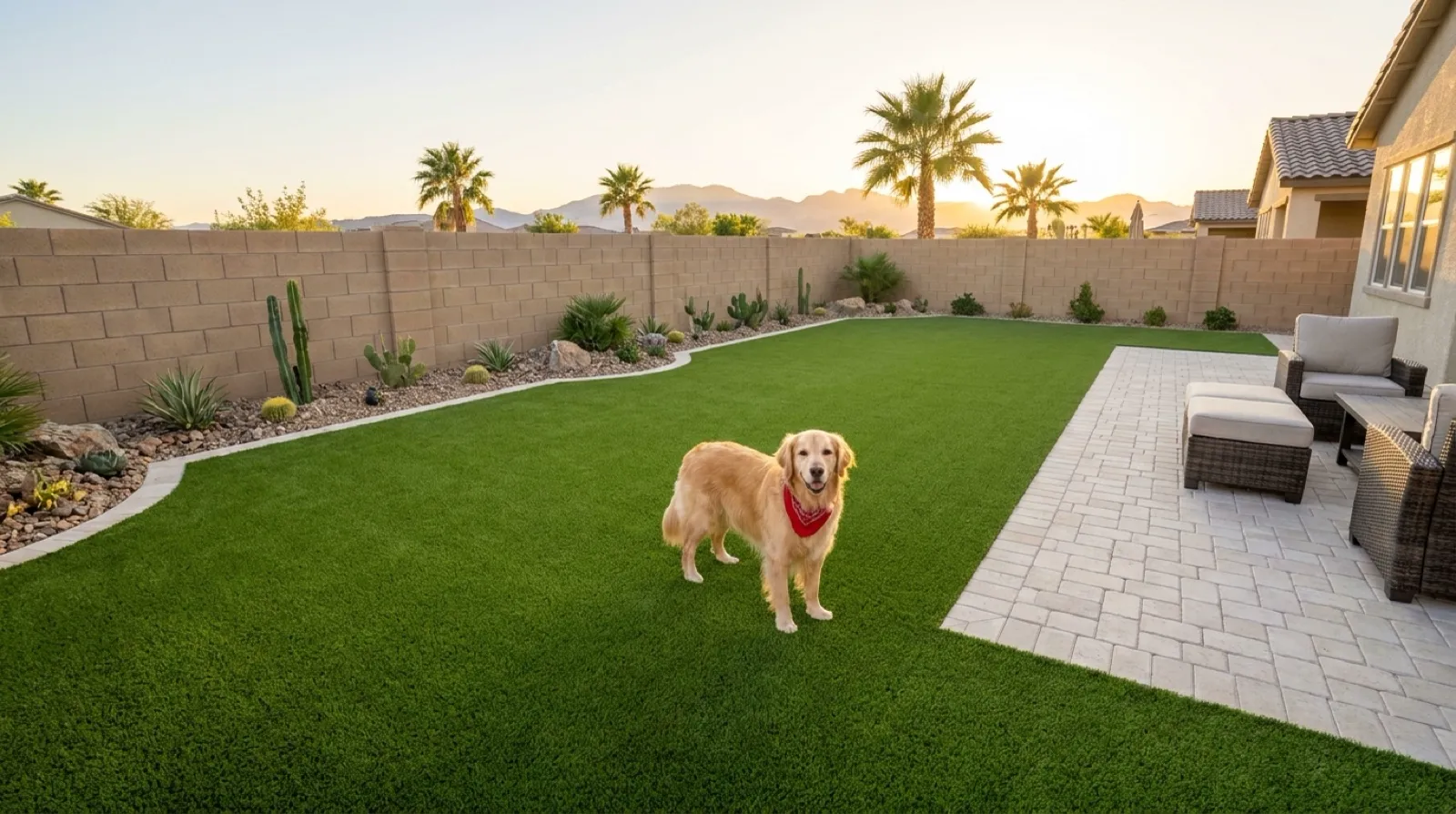
Why a dedicated run works in a desert yard
Three reasons it works better here than in most climates.
First, Vegas yards are hard to search. Decorative rock hides waste until you are standing on it, and artificial turf makes small waste practically invisible from a standing position. A defined area cuts that search down to something you can scan in a glance.
Second, the dog is already concentrating its traffic whether you planned it or not. It has picked a spot, usually the shaded strip beside the house, which is the worst possible location for it. Building a run is mostly the act of choosing that spot deliberately instead of letting the dog choose it.
Third, it protects the rest of the yard. Patio, planted beds, the section where kids play, and any grass you water all stay out of the traffic pattern.
If the reason you are reading this is that your dog has already claimed the side yard, read the post on side yard dog poop and why that strip goes bad first before you plan anything. Understanding why the dog picked it tells you what your run has to compete with.
Picking the spot and the surface
Location decides whether the run is a good part of the yard or the corner nobody goes near.
Sun, shade, and airflow
Shade for part of the day. Not full shade, because full shade means nothing ever dries out, and not full sun, because a dog will not use a surface that is uncomfortable in the afternoon. Something with morning sun and afternoon shade tends to work. A tree, a wall, a patio overhang, or a shade structure all count.
Air movement. Nobody considers this and it is the difference between a run and a problem. Air has to move through the space. A run boxed in on three sides by walls holds odor the way a side yard does. If your only option is enclosed, plan on cleaning it more often and accept that as the cost.
Drainage away from the house. Water should flow away from the foundation and away from the patio, not toward either. Check where the yard actually drains before you commit, ideally by watching it during a rain or after a deep watering rather than by guessing from the way it looks.
Distance from windows and the patio. Far enough that odor is not sitting where you sit, close enough that you will actually maintain it. A run at the far back corner of a big lot is the one that gets skipped in July.
Surface and drainage
There is no universally correct material. Ask two things about anything you are considering. Does water pass through it, and how hot does it get in the afternoon? A surface that holds liquid becomes a permanently damp spot, which in a concentrated use area is exactly what you are trying to avoid. A surface that bakes is one the dog will refuse to use in summer, which means you built a run and the dog is back on the patio.
What is under the surface matters as much. A run works better on a base that drains than on compacted dirt, and better when the area has a slight fall so nothing pools in the middle. That is a landscaper's job if you are not comfortable doing it, and getting it wrong is expensive to correct later.
For a material by material breakdown of how decomposed granite, pea gravel, river rock and mulch each behave under daily dog use, the post on the best ground cover for dogs in a Las Vegas yard goes through them one at a time.
Size, fencing, and gates
Size is dog dependent and I am not going to hand you a number that pretends otherwise. Big enough that the dog can move around and pick a spot within it, small enough that you can clear the whole thing quickly. A run so large it becomes a second yard defeats the purpose.
- Height and containment depend on your dog, not on a standard. A jumper and a digger need different solutions and you know which one you have.
- A visible boundary helps the habit. Dogs read edges. A low fence, a border of a different material, or a change in surface all communicate where the space starts better than an imaginary line does.
- The gate should be wide enough to work in. You will carry a bag and a tool through it several times a week, and a narrow gate that swings the wrong way turns into a skipped cleaning.
- Leave a clear path to it. If getting to the run means squeezing past patio furniture, it will get visited less.
If you would rather not maintain it yourself at all, you can get a quote for regular yard cleanup and have the run cleared on a set weekday along with the rest of the property.
Keeping it from becoming the smelliest corner of the yard
This is the section most build guides leave out, and it is the one that determines whether you are happy with the run in a year.
You have deliberately created the highest concentration of waste on your property in the smallest area. In this climate, in summer, that area will announce itself if it is left. A run needs more frequent attention than a spread out yard, not less, because everything that used to be diluted across a quarter of a lot is now happening in one square.
- Clear it daily or close to it. A run cleared every day is barely noticeable. A run cleared weekly in August is a problem you can smell from the patio.
- Remove, do not rinse. Hosing pushes residue down into the surface and into the base. Solids come out first, every time.
- Do not store anything in it. Bins, hoses and leftover pavers create covered spots that never get cleaned and never dry.
- Watch the low corner. Every run develops one, and it needs specific attention rather than a pass with a rake.
- Reassess after the first summer. If the location has a problem, the first hot season will tell you clearly.
Training the dog to use it, and when a run is not the answer
Building it is the easy half. Getting the dog to treat it as the spot is a behavior project rather than a construction project, and the full approach is in the post on training a dog to poop in one spot.
Be realistic about when a run is not the right call. A very small yard may not have room to surrender a section. A dog that is outside for five minutes at a time may never build enough repetitions to form the habit. A household that is not going to clean a concentrated area several times a week ends up with a worse smell in a smaller space. A run is a good tool for a specific situation, not a default, and not a fix for a routine that is not happening.
Common questions
Does a run mean less cleanup?
Less searching, not less cleaning. The area is smaller and faster to clear, and it needs clearing more often.
What surface should I use?
Whatever drains well and does not get uncomfortably hot in the afternoon. Those two questions matter more than the material name.
Where should it go?
Partial shade, some airflow, drainage away from the house, and close enough that you will actually maintain it.
How long does training take?
It varies by dog and by how consistent you are. An adult dog with established habits takes longer.
Can you service a dog run?
Yes, as part of the regular walk along with the rest of the yard.
Getting the run on a routine
The build is a one time project. The maintenance is what decides whether you are glad you did it.
Get a quote for regular dog waste removal. Service runs Monday to Friday on a fixed day, the run and the rest of the yard both get walked, waste goes double bagged into your own trash bin on the property, and a photo of the cleared yard lands on your phone. Call or text (725) 200-2028.
Want your exact monthly price for this yard? The quote form takes about 60 seconds.
Get my free quote