
Quick answer
Why is my senior dog going closer to the door?
Older dogs shorten the trip, so traffic moves from the far corner to the patio and door zone, where porous concrete stains fastest and hot Las Vegas ground and poor footing limit where a dog will still walk. Clear that zone daily and rinse promptly. Any change in frequency, consistency, or control goes to your veterinarian.
Senior dog accidents in the yard usually show up as a pattern rather than an event. The dog is going more often. It is going closer to the door. The timing is less predictable than it was. Nothing dramatic happened, and yet the yard is a different job than it was a year ago.
Standard disclaimer, and it matters here more than usual: I scoop yards, I am not a veterinarian. Any change in how often your dog goes, in consistency, or in control belongs in front of your vet rather than filed under getting old. I am not going to guess at a cause and neither should you.
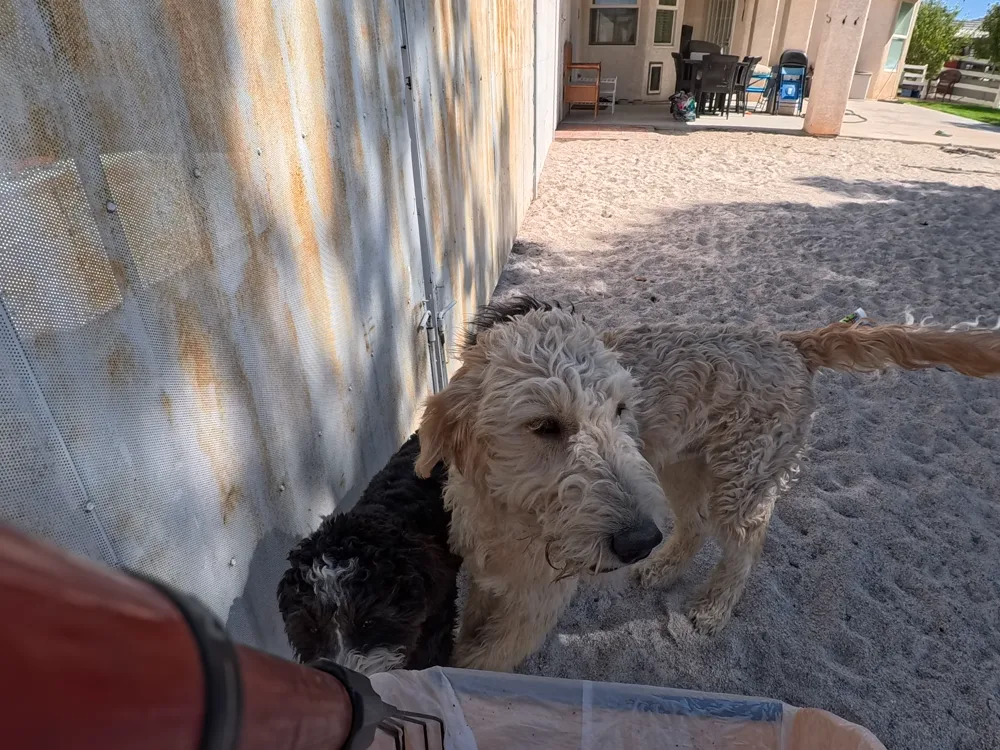
What Changes as a Dog Gets Older
First, a quick signpost, because the names are confusingly similar. There is a separate post on this site about yard cleanup help for older homeowners, and that one is about people: mobility, bending, and doing a chore that has gotten hard. This post is about older dogs. If you landed here looking for the other one, that link is where you want to go.
What owners of aging dogs describe in the yard tends to fall into a few buckets. More frequent trips outside. Less warning before the trip is needed. A shift in where in the yard it happens. Sometimes a change in consistency. And a general narrowing of the territory the dog is willing to cover.
Every one of those is worth mentioning to your vet, even if it seems minor and even if you are fairly sure it is just age. Vets would rather hear about it early. The yard side of it, which is what I can actually help with, is what the rest of this post covers.
More Frequent, Less Predictable, Closer to the Door
The most practical consequence of aging, from a yard perspective, is concentration.
A younger dog will trot to the far corner because the far corner is where it has always gone. An older dog will not, and the reason is usually mundane: the trip is longer, the surface is less comfortable, and the margin between needing to go and going has narrowed. So the traffic moves toward the door.
That is a real change in the cleaning problem, not just a change in the dog. The area right off the patio is the area you actually walk through, the area you sit next to, and often the area with the least forgiving surface. Waste that used to be out of sight in the gravel is now six feet from where you drink your coffee.
It also means the yard gets behind faster. More frequent trips into a smaller zone concentrates everything. A schedule that worked fine for years can quietly stop being enough without anything else changing.
Patios, Concrete, and the Spots That Take the Hit
Hard surfaces are the part people underestimate.
Concrete, pavers and stamped patios are porous. Anything that sits on them in Las Vegas sun does not just sit, it sets in, and the window where it comes up easily is short. Turf right at the patio edge has a similar problem for different reasons, because the backing holds what soaks through and the seam at the concrete edge traps it.
The rule that actually helps is time, not product. Prompt removal and a rinse beats a heroic effort three days later. The detailed version, including what to do when something has already set, is in the guide to dog waste stains on a concrete patio.
And if consistency has changed and you are dealing with a runny mess on a hard surface, that is its own job with its own approach. The dog diarrhea yard cleanup guide covers it. Also, and I will say it again, that is a call to your vet.
Heat, Traction, and Where an Older Dog Can Still Get To
Two Las Vegas specific things stack on top of normal aging.
Heat is the first. Ground surface temperature in summer is brutal on gravel, dark turf and concrete, and it stays brutal long after the air starts cooling in the evening. A dog with less tolerance and less padding is going to refuse ground it used to cross without thinking. That refusal is sensible, not stubborn, and the yard routine should bend around it rather than fight it.
Traction is the second. Older dogs lose confidence on surfaces that slip, and smooth concrete, wet tile at the door and loose gravel on a slope all qualify. A dog that is unsure of its footing will not go where it has to cross that footing. Sometimes an accident closer to the house is really a traction problem in disguise.
What tends to work is making the reachable zone a good one: shade over it, footing the dog is confident on, and a short clear path from the door. What does not work is trying to send an aging dog back to a corner it has decided against. Anything about heat, footing or pain and your specific dog goes to your vet, who may have practical suggestions that have nothing to do with the yard.
Keeping the Yard Clean Without Wearing Yourself Out
Here is the honest situation a lot of households end up in. The dog needs more frequent cleanup exactly when the owner has the least appetite for it, because caring for an aging animal is already taking energy in a dozen other ways. Vet visits. Medication schedules. Waking up at night. The yard is the thing that slips, and then it slips further.
A few practical adjustments that do not cost anything:
- Handle the patio and the door zone daily, since that is where the concentration moved.
- Rinse hard surfaces promptly rather than scrubbing them later, and if the patio has started holding odor, that is what a sanitizing and deodorizing visit addresses.
- Keep a clear, shaded, confident path from the door to a reachable spot.
- Do the outside work early, when the ground is tolerable for both of you.
- Raise the frequency of a full yard clear rather than trying to catch up on one big session.
And the honest commercial note, since this is my blog: this is one of the more common reasons people call. Not because they cannot do it, but because they would rather spend the energy on the dog than on the yard. If that is where you are, the quote form prices a routine for your property in about a minute.
Ask Your Vet What Is Normal Aging and What Is Not
I want to end where I started, because it is the most important line in this post.
Frequency, consistency, control and where a dog chooses to go are all things your veterinarian wants to know about. Some of what happens in an aging dog is ordinary. Some of it is not, and the difference is not something an owner can reliably call from the yard. Write down what changed and roughly when it started, and bring that to the appointment. That kind of specific observation is genuinely useful to a vet.
Nothing on this page is a diagnosis, a cause, or a reason to wait and see.
If the yard is the part you would rather hand off while you focus on your dog, the quote form gives you a real price for your property in about a minute, with photos after every visit. Or call or text (725) 200-2028, Monday through Friday.
Get my free quoteCommon Questions
Why is my older dog pooping more often?
Bring it to your vet rather than filing it under age. Note what changed and when.
Is it normal for a senior dog to go closer to the back door?
It is a very common pattern as the trip gets longer and the margin gets shorter. Whether it means anything medically is a vet question.
How do I keep the patio from staining?
Prompt removal and a rinse. Time on the surface is what sets a stain, not the surface itself.
My older dog will not walk on the hot gravel anymore.
Give them a shaded, confident route to a reachable spot instead of sending them back to the old corner.
Is this post about older dogs or older people?
Older dogs. The post about yard help for older homeowners is a separate one, linked above.
Want your exact monthly price for this yard? The quote form takes about 60 seconds.
Get my free quote