Quick answer
How do I get dog poop stains off concrete?
Lift the solids without wiping, blot the residue with paper towels, then apply an enzymatic pet cleaner and let it dwell before you scrub and rinse. Rinsing first is the common mistake, since water carries residue down into the pores of a hot Las Vegas patio instead of pulling it out.
Dog poop stains on a concrete patio are a different problem from a mess on grass or rock, and they need a different approach. Grass forgives you. Concrete keeps a record. Once something has been sitting on a Las Vegas patio in the sun for an afternoon, you can remove every trace of the solids and still be left with a mark and a smell.
This post is about hard surfaces: concrete, pavers, stamped patios, walkways, and the slab in the side yard. If the whole yard smells rather than one spot, that is usually urine and it is covered in the guide to dog urine smell in a Las Vegas yard. Two different problems, two different fixes.
Why concrete and pavers hold onto it
Concrete looks solid. It is not. Cured concrete is full of tiny pores and capillary channels, and it behaves a lot more like a very hard sponge than like a tile.
When waste sits on it, three things happen. Liquid and dissolved organic material wick down into those pores. Pigments from the waste bind to the cement paste at the surface. And bacteria get a food source that is now protected below the surface, which is where the lingering smell comes from.
Pavers add a second issue: joints. Even tight paver joints are filled with sand or polymeric sand, and that fill is far more absorbent than the paver itself. A lot of the time the paver is fine and the joint is what is holding the odor.
Las Vegas makes both worse in a specific way. A patio surface in July gets extremely hot. Heat drives liquid deeper and faster, dries residue into the pores rather than letting it sit on top, and speeds up the bacterial activity that produces smell. The same mess handled in twenty minutes and the same mess found four hours later are not the same job.
Sealed versus unsealed surfaces
Before you buy anything, find out which one you have. It changes the whole plan.
How to tell
Put a small amount of water on the surface in an inconspicuous spot. If it beads or sits on top, you have a sealer. If it soaks in and darkens the concrete within a few seconds, you do not.
Sealed concrete and most pavers
Good news. The sealer is doing its job, the stain is sitting on a barrier rather than in the concrete, and most messes come off completely with a gentle cleaner and a scrub. Your main caution is choosing products that do not attack the sealer. Anything strongly acidic or heavily solvent based can dull or strip it, and then you have traded a stain for a permanent dull patch.
Unsealed or old broom finish concrete
This is the harder case, and it is common on older Las Vegas homes and on side yard slabs that were never finished nicely. The surface is porous, often rough, and the texture holds material mechanically as well as chemically. Expect to work harder, expect enzymatic treatment to matter more, and set expectations that a faint shadow may remain.
Sealing after you have cleaned it is worth considering. A sealed patio is dramatically easier to keep clean going forward, and in a household with dogs that pays for itself in effort.
What to do in the first hour
Speed matters more than product choice. Here is the order that works.
- Lift, do not wipe. Get the solids off with a scoop or a stiff piece of cardboard. Wiping smears residue across a wider area and grinds it into the texture.
- Blot the residue. Paper towels, pressed down, lifted straight up. You are trying to pull material out, not push it around.
- Do not hose it yet. This is the most common mistake and it is covered below.
- Apply an enzymatic pet cleaner generously enough to stay wet on the spot. Enzymes need contact time to break down the organic residue, so follow the label dwell time rather than spraying and immediately rinsing.
- Scrub with a stiff bristle brush along the direction of the surface texture, then across it. A broom finish has grooves and the residue lives in them.
- Now rinse and let it dry fully before you judge the result. Wet concrete always looks worse than dry concrete.
Products that help and products that damage the surface
Worth using: enzymatic cleaners formulated for pet waste, oxygen based cleaners on unsealed concrete, plain dish soap and hot water as a first pass on a fresh mess, and a stiff nylon brush. A commercial grade sanitizing treatment is the strongest option and it is what our yard and patio sanitizing service is built around.
Use with real caution: chlorine bleach. It lightens colored, stained, and stamped concrete unpredictably, it kills plants wherever the runoff goes, and it deals with smell by covering it rather than removing the cause. Muriatic acid belongs to a different category of job entirely and will etch a residential patio. Wire brushes gouge sealers and pavers.
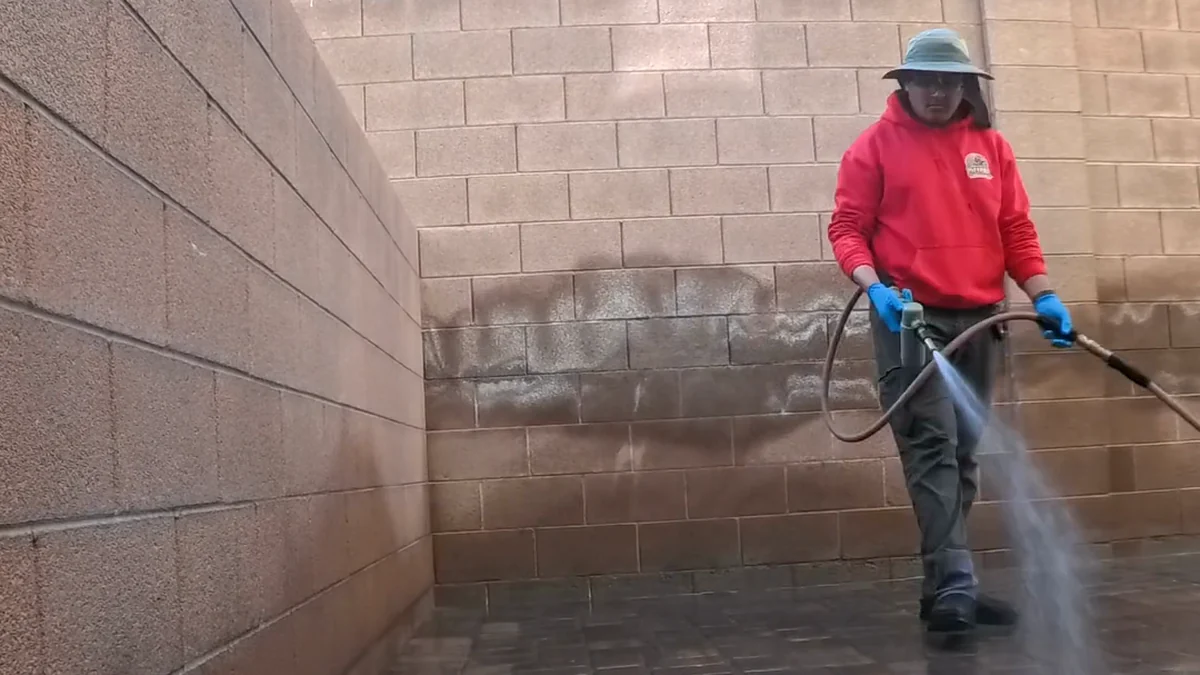
Not the answer: stronger water. A very forceful spray on old concrete lifts the surface paste, leaves a visibly cleaner patch that highlights the rest of the patio, and blasts joint sand out from between pavers, which then has to be replaced. If your patio is near a pool, forceful spraying also pushes contaminated water toward the deck and the skimmer, which is a separate headache covered in the guide to dog waste around a Las Vegas pool.
If the patio has been an issue for a while and you would rather have it handled properly, you can get a quote that includes sanitizing along with regular yard service.
Why the smell survives a rinse
Because rinsing solves the wrong half of the problem.
Water carries dissolved organic material down into the pores rather than out of them. The visible stain fades because you have diluted the surface, so it looks like a success. Then the patio dries, the residue is still down there, the afternoon heat warms it, and the smell comes back off a patio that looks perfectly clean. Owners then rinse again, push it deeper, and repeat the cycle all summer.
Breaking the cycle takes something that digests the residue rather than relocating it, which is what enzymatic products and proper sanitizing solutions do. That is also why the order in the previous section matters: lift and blot first, treat second, rinse last.
Keeping the patio out of the rotation in the first place
The permanent fix is not a product. It is that the dog stops choosing the concrete.
Dogs use hard surfaces for reasons. The rock or grass is too hot and the shaded slab feels better. The yard already has too much in it. It is dark and the patio is the lit part. Or the patio is simply closest to the door.
Which means the useful moves are:
- Keep the yard cleared. A yard with nothing in it stays in the rotation. A yard with a backlog pushes the dog toward the patio.
- Add shade or a cooler surface so the dog is not choosing the slab for comfort in summer.
- Light the yard at night. A lot of patio use is just visibility.
- Rinse the patio on a schedule rather than only when there is a problem, so residue never accumulates.
Weekly service handles the first one automatically, which is usually enough. Waste goes into your own trash bin on site, the patio and walkways get covered every visit, and you get a photo afterward. Service runs Monday to Friday.
Common questions
Will the stain fully come out?
On sealed concrete and pavers, usually. On old unsealed concrete, often not completely, and a faint shadow is a fair trade for keeping the surface undamaged.
Is bleach safe on my patio?
It is risky on colored or stamped concrete, it harms nearby plants, and it hides odor rather than removing the cause. Enzymatic cleaners are the better tool.
What about the sand between my pavers?
Joint sand absorbs more than the pavers do. Treat the joints directly, and expect to top up joint sand if it gets washed out.
How long do I let an enzyme cleaner sit?
Follow the label. The common failure is rinsing too early, since enzymes need time on a wet surface to work.
Do you treat patios as part of regular service?
The patio and walkways are part of every scooping visit. Sanitizing is a separate treatment you can add if the surface already has an odor history.
If the patio has become the part of the yard you avoid, get a quote here or call or text (725) 200-2028. Clear it, treat it, then keep it out of the rotation.
If the smell is following people indoors rather than staying on the patio, dog poop tracked into the house covers paws, shoes, and the mat by the back door.
Want your exact monthly price for this yard? The quote form takes about 60 seconds.
Get my free quote