Quick answer
How do you clean dog diarrhea out of the yard?
Absorb first, then lift, then treat, and rinse last if at all. Lay paper towel, dry sand, or plain cat litter on the mess, let it pull moisture out, and lift everything with a flat tool before applying an enzyme cleaner. Hosing first spreads it wider and drives it deeper, which matters more on Las Vegas rock and turf.
Figuring out how to clean dog diarrhea from your yard is a different problem from normal scooping, and the difference is physical. Solid waste sits on top of a surface and lifts off it. Runny waste soaks into whatever it lands on. That is why the usual approach fails and why the instinct most people have, which is to grab the hose, makes it worse. Here is the order that actually works on grass, turf, rock, and concrete in a Las Vegas yard.
One note on scope before the steps. This post is about the acute mess and the cleanup right after it. If your yard smells and there is nothing visible to pick up, that is usually urine, and the dog urine odor guide is the right page for that.
Why this is harder than a normal cleanup
Three things are working against you at once.
It has no structure, so there is nothing to pick up. A scoop needs something to scoop. With diarrhea there is no intact mass, so any tool you push into it just moves it sideways and increases the footprint.
It penetrates. On grass it goes past the blades into the thatch and soil. On turf it goes through the fibers into the infill and down to the backing. In rock it goes between the stones and under them. On concrete and pavers it goes into the pores. In every case the part you can see is a fraction of what is there.
And in Las Vegas, heat accelerates all of it. A surface at midday temperature bakes residue in place fast, which is why a spot cleaned two hours later is a genuinely different job than a spot cleaned right away.
Grass, turf, rock, and concrete each need a different approach
Grass
Do not scrape. Lay something absorbent directly on it, paper towel, dry sand, or plain cat litter, and give it a minute to pull moisture out of the mess. Then lift the whole thing with a flat tool, like a dustpan or a piece of stiff cardboard, in one motion toward the center. Bag it. Repeat with fresh absorbent material if there is a second layer. Then treat the spot with an enzyme cleaner and let it sit as long as the label says.
Artificial turf
Same absorb-then-lift approach, but work with the fiber direction instead of against it so you are not pushing residue further down into the infill. Turf is the surface where the smell outlasts the visible mess by the widest margin, because the infill holds what soaked through. Enzyme treatment on turf is not optional if you want the spot to stop announcing itself in the afternoon.
Rock and gravel
This is the least forgiving surface. Lift the top stones out of the affected area and bag them or set them aside, clear what is underneath, and treat the exposed ground. Trying to clean rock in place mostly redistributes the problem into a wider circle. If it is a small area, replacing that patch of rock is a legitimate and faster answer than fighting it.
Concrete and pavers
Absorb and lift the same way, then treat. Sealed concrete releases most of it. Unsealed concrete and porous pavers hold onto some staining and some odor no matter how carefully you work, and it is better to know that going in than to keep attacking the same spot. Enzyme cleaner, dwell time, and repetition beat aggressive scrubbing.
The rinse mistake that spreads it
Almost everyone reaches for the hose first. It feels like the fastest fix and it is the one step that reliably makes the job bigger.
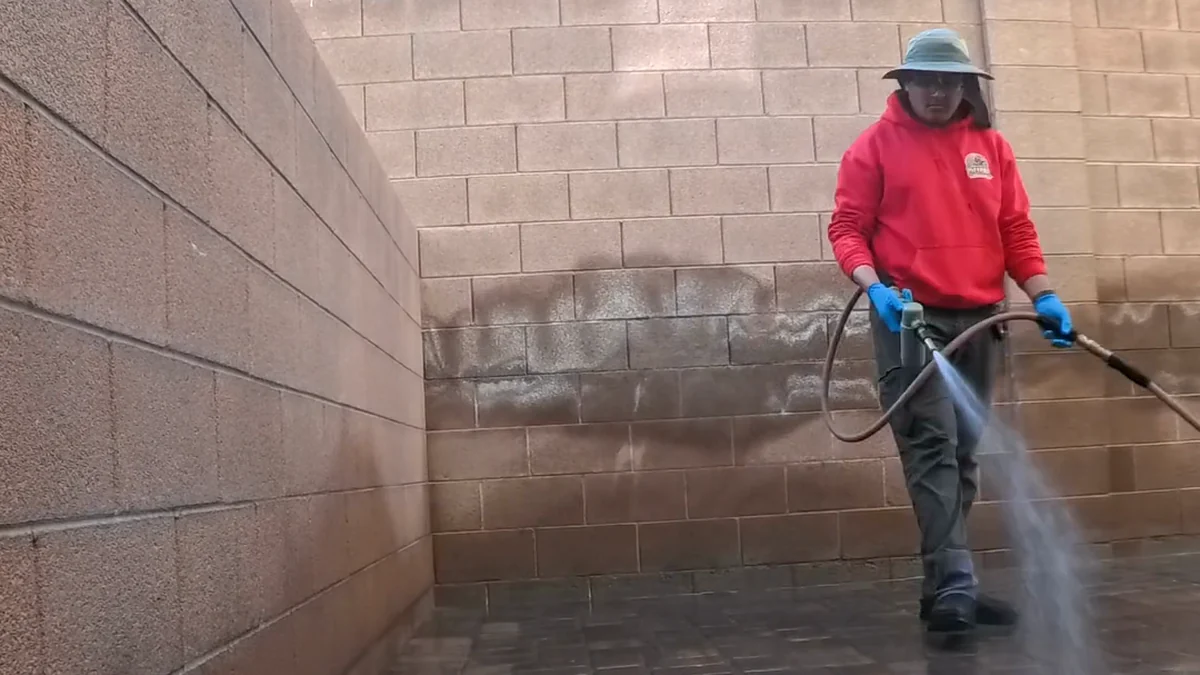
Water does not remove organic material from a porous surface. It dilutes it and carries it. On grass, that means a two foot problem becomes a six foot problem and the residue goes deeper into the soil. On turf it flushes material down into the infill where you cannot reach it. In rock it washes residue under the stones. On a sloped Las Vegas lot it moves the whole thing downhill toward a wall, a drain, or the patio.
Rinsing has a place, but it belongs at the end, after the solids and the absorbent material are gone and after an enzyme treatment has had time to work. Even then, use less water than you think you need.
When to sanitize the area
Enzyme cleaner handles the residue you left behind. Sanitizing is a step past that, and it is worth doing when the same area has taken repeated hits, when the dog has been sick more than once, when kids or another dog use that part of the yard, or when the smell is still there after you have cleaned properly twice.
A yard sanitizing treatment covers the whole surface rather than one spot, which matters because a sick dog rarely uses one spot. That is what the yard sanitizing and deodorizing service is for. It will not make a yard sterile and nobody should tell you it does. What it addresses is the organic residue and the odor that scooping leaves behind.
If the diarrhea is happening around an unvaccinated dog or a puppy, read the parvo and your yard guide before you do anything else, and call your vet first. That situation has different rules.
When it is a health signal and not a yard problem
This part matters more than the cleaning. I clean yards, I am not a vet, and none of this is veterinary advice.
Call your vet if the diarrhea lasts more than a day, keeps coming back, or shows up with blood, vomiting, lethargy, or a dog that will not eat or drink. Call sooner for a puppy, a senior dog, or any dog that has not finished its vaccinations. Dehydration moves quickly in this climate, and a yard you can clean tomorrow is not the urgent item.
Keeping it from happening in the same spot
Once a spot has been hit, dogs return to it. Scent marks the location and the behavior reinforces itself, which is why the same corner keeps getting used. Breaking that pattern means fully neutralizing the odor there rather than just clearing the surface, and then giving the dog an obviously better option nearby.
The broader protection is simply not letting waste accumulate between incidents. A yard that is already carrying a week of buildup gives you nothing to work with when something like this happens, because you cannot tell the new problem from the old one. A yard that gets cleared on a routine gives you a clean baseline and a single spot to deal with. If you would rather not be the one dealing with any of it, the instant quote takes about a minute.
Common questions
What is the fastest way to clean diarrhea off grass?
Absorbent material on top first, then lift the whole thing with a flat tool, then enzyme cleaner. Skipping the absorb step is what turns a five minute job into a twenty minute one.
Will hosing it down work?
No. Water spreads it wider and pushes it deeper. Rinse only at the end, if at all.
Is bleach safe to use out there?
It damages grass and turf backing, can discolor concrete and pavers, and is not something to leave where a dog walks. Use an enzyme cleaner made for pet waste instead.
Do I need the yard sanitized after one incident?
Usually not. One incident cleaned properly is fine. Repeated incidents, a lingering smell, or shared use of that area by kids or another dog are the reasons to treat the whole surface.
If cleanup like this keeps landing on you, a routine visit keeps the yard at a clean baseline so a bad day is a single spot instead of a project.
Get my free quoteIf the pattern is age rather than a one-off bad day, senior dog accidents in the yard covers what changes as a dog gets older and why any change in frequency belongs in front of your vet.
Two things usually follow a bad week: your vet asking for a stool sample, which is genuinely harder to collect in a rock yard, and a food change, which shows up in the yard before it shows up anywhere else.
Back to the blog