
Quick answer
How often should a large dog yard be cleaned?
Weekly is the starting point for most single large dog homes in Las Vegas, and twice weekly fits small yards, kids using the space, or the summer months. A big dog leaves more per deposit, more residue, and more physical wear, so the worn path along a wall is a landscaping problem rather than a scooping one.
Large dog yard cleanup in Las Vegas is its own category, and it surprises people who assumed one dog meant an easy yard. A single large breed can genuinely be more work than several small dogs, and the difference shows up in ways beyond the obvious. This post is about size, not about how many dogs you have. If the question you actually have is about a household with three or four dogs, the post on multiple dogs and yard waste covers dog count. This one covers one or two big ones.
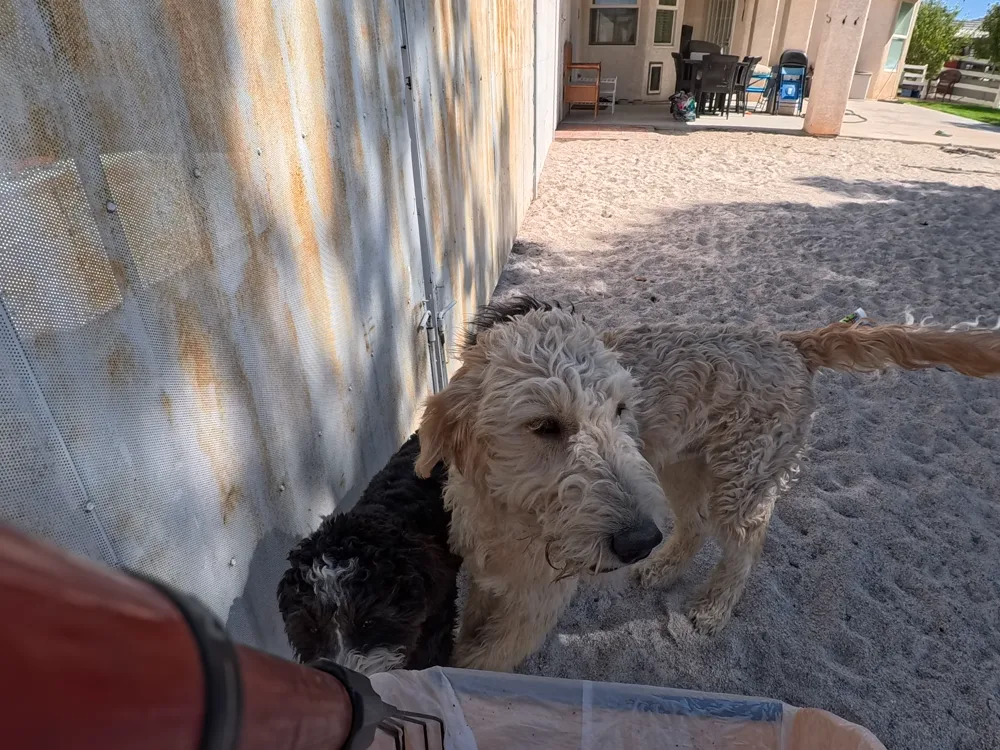
Why One Big Dog Changes the Math
Start with the obvious part and then get to the part nobody warns you about.
The obvious part is volume. A large breed produces meaningfully more per deposit than a small dog. I am not giving you a multiplier, because it varies with the individual dog, the diet, and the day. But the practical effect is real: a yard with one large dog reaches "somebody needs to deal with this" noticeably faster than a yard with one small dog.
The part people miss is that everything downstream scales too:
- More mass on the surface means more residue left behind when it dries and breaks up.
- More weight on the ground means more physical wear on turf, grass, and loose material.
- Bigger stride, wider range means it is spread across more of the yard rather than concentrated in one corner.
- Bigger dog, more water, which matters in a Vegas summer more than in most climates.
So the honest framing is not "one dog, easy job". It is a yard that is being used harder in every dimension by a single animal.
Volume, Weight, and What That Does to Grass and Turf
Surface damage in a big dog yard comes from two different causes, and owners usually blame the wrong one.
Cause one is what sits on the surface. Waste left on living plant material affects what is underneath it, and the more mass sitting there the more obvious it gets. That specific mechanism is covered in the post on whether dog waste damages grass in a Las Vegas yard.
Cause two is mechanical, and it is usually the bigger factor with a large dog. Weight compresses the ground. Repeated running along the same line compacts it into a track. On real grass that shows as thinning. On artificial turf it shows as flattened, matted blades that never stand back up. On decomposed granite it shows as a hard packed path that stops draining.
The reason this matters for cleanup is that compacted ground behaves differently. It does not absorb, it does not drain, and material sits on it rather than passing through. A hard packed track along the wall is often the smelliest line in the yard even though it is not where the dog goes.
Big Dogs, Worn Paths, and Bare Spots
Almost every large dog yard I work in has a visible route: along the wall, around the perimeter, from the back door to the gate, or a figure eight around whatever is in the middle. Once you see it you cannot unsee it.
Two practical things follow.
First, the path tells you where to look. Dogs rarely choose the path itself as a spot. They choose just off it, usually in shade, usually at a corner. If you are scooping your own yard and you feel like you are missing things, walk the edge of the path rather than the middle of the yard.
Second, the path is a landscaping problem, not a scooping problem, and pretending otherwise wastes money. If a route has worn in, the options are to work with it, put a durable material on it, or change the layout so the route moves. Replanting the same grass into the same track is a losing bet.
Heat, Hydration, and Why Summer Output Changes
Owners regularly tell me things look different in the yard during the hottest months, and there are ordinary explanations that have nothing to do with anything being wrong.
Big dogs drink a lot of water in a Las Vegas summer. Routines change: walks move earlier or later, activity drops in the middle of the day, and time outside shifts to the cooler ends of the day. Appetite can change in heat too. All of that shows up in the yard.
Two things I will say plainly. One, this is a general observation from working in yards, not a medical statement, and I am not qualified to make one. Any real change in frequency, consistency, or your dog's habits is a question for your veterinarian, and it is worth asking rather than watching. Two, whatever the cause, summer is when a yard goes from manageable to unpleasant fastest, because heat accelerates odor and flies more than any other factor here.
How Often a Large Breed Yard Needs Service
The three inputs are the same as always: how many dogs, how big the yard, how often you want it clear. Size shifts the answer up.
Common patterns with one large dog:
- Weekly works for most single large dog households with a normal sized backyard.
- Twice weekly is common where the yard is small, where kids use it, or through the summer months.
- Seasonal switching is very common: heavier through the hot months, lighter in winter.
The combination that most often needs the higher frequency is a large dog in a compact tract backyard, because the volume is high and the ground to absorb it is limited. That is an extremely common Las Vegas setup.
The quote form asks the three questions and gives you a real number for your yard. If you are on the fence between weekly and twice weekly, start weekly. It is easy to move up after a month of seeing how the yard actually behaves.
What to Tell a Scooper About Your Dog Before the First Visit
Big dogs are not a problem. Surprises are. Four things worth mentioning when you book:
- Will the dog be out during the visit? Either answer is fine, I just need to know before I open a gate.
- How does the dog handle a stranger arriving? If your dog is protective, reactive, or simply enormous and enthusiastic, say so. The usual arrangement is having the dog inside during the visit, which takes a few minutes and makes it faster for both of us.
- Where does the dog usually go? You know the corner. Telling me saves a lap.
- Anything fragile out there? Irrigation, a garden, a repair in progress.
One person runs my routes, so after the first couple of visits I already know your dog and your yard. That continuity is worth more with a large dog than with almost any other customer, because a dog that has met the same person twice stops treating the gate as an event.
If you are reading this because you have the opposite situation and someone told you a small dog does not need service, the other half of this pair is the post on whether small dogs need a pooper scooper.
Big dog, small yard, and a routine that keeps slipping? That is the most common call I get. Tell the quote form how many dogs, how big the yard is, and how often you want service, and you will have a price in about a minute. Or call or text (725) 200-2028, Monday through Friday.
Get my free quoteCommon Questions About Large Dog Yards
Is one big dog really as much work as several small ones?
Often, yes. More per deposit, more residue, and more physical wear on the ground. The exact comparison varies by dog and diet.
Why does my turf or grass look worse?
Usually mechanical wear from weight and repeated routes, not only what sits on the surface. Worn paths do not scoop away.
How often should I book?
Weekly for most single large dog homes, twice weekly for small yards and summer months.
Does summer change anything?
Owners often notice a difference in the hot months. Any real change in your dog is a vet question, not a scooper question.
What should I tell you before the first visit?
Whether the dog is out, how it handles strangers, where it usually goes, and anything fragile in the yard.
A big dog and a stranger at the gate is its own question, and whether your dog can be outside during a visit answers it honestly rather than with a policy.
Want your exact monthly price for this yard? The quote form takes about 60 seconds.
Get my free quote