
Quick answer
Do I have to put my dog inside when the pooper scooper comes?
No, not as a rule. Most dogs stay outside during the visit in Las Vegas yards and it goes fine. It is the owner's call rather than a policy. The only thing that matters is telling your scooper which you want before the first visit, so nobody is standing at a gate guessing what to do.
Can my dog be outside during pooper scooper service is one of those questions people feel slightly silly asking, and it is actually one of the most sensible ones on the list. You are inviting somebody into the one space your dog considers its own. The honest answer is that most dogs handle it easily, some do not, and you already know which one you have. What you should not do is leave me to find out on the first visit. This post covers both cases and what to say up front.
The Short Answer
Your dog can be outside, and there is no rule saying otherwise. It is your decision, not a policy you have to comply with.
People expect a policy because a lot of home services have one, usually because they involve equipment, chemicals, open doors, or several people moving in and out. A scooping visit is none of that. It is one person walking a yard, quietly, for a few minutes, then latching the gate and leaving.
So treat this as a preference to state rather than a hurdle to clear. Say "he stays out, he is fine" or say "please wait until she is inside", and that is the entire arrangement. The general version of this answer also lives on the what about my dogs page.
Dogs Who Are Fine Outside, and How the Visit Goes
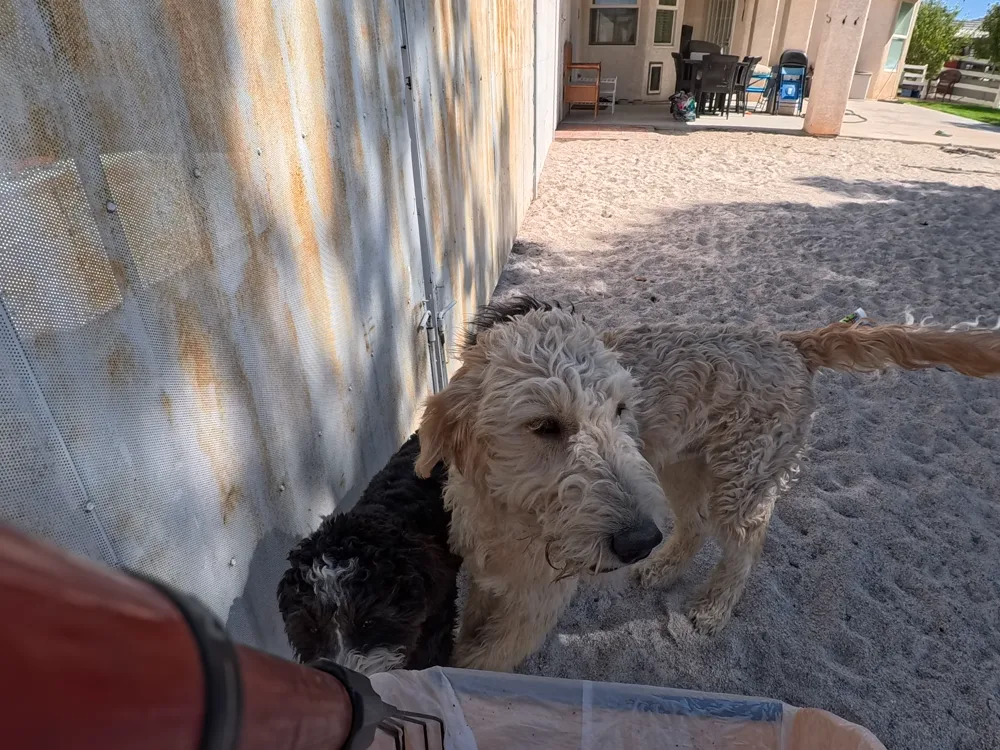
The majority. It usually plays out the same way: mild interest, a short escort around the yard, and then the dog goes back to whatever it was doing.
A few things make it a non event:
- It is short. There is nothing to endure.
- It is quiet. No machines, no blowers, no noise a dog needs to react to.
- It repeats. Same day, same person. Dogs adjust to routine faster than they adjust to anything else, and by the third or fourth visit most of them barely look up.
- Nobody is going into your house. The whole visit happens on the dog's side of the door, which is less confusing for the dog than it sounds.
Some dogs stay genuinely interested, and that is fine too. Following a person around the yard is not a problem. If your dog is the type to try to help by carrying something off, mention it, because that is worth knowing before it happens rather than after.
Dogs Who Should Be Inside for the Visit
There is a group where inside is simply the easier call, and none of it is a judgment about the dog.
- Dogs who are uncomfortable with people they do not know. If a stranger in the yard is genuinely stressful for your dog, there is no reason to put it through that every week.
- Dogs who guard the yard specifically. Plenty of dogs are relaxed everywhere except behind their own gate. You know if that is yours.
- Dogs who bolt. If your dog treats an opening gate as an opportunity, inside removes the whole issue.
- Dogs recovering from something. Post surgery, sore, or on rest orders from your vet. Anything medical is your veterinarian's call, not mine.
- Puppies and very new arrivals. A dog still working out what its own yard is does not need a new variable in week one. The post on the first 30 days with a rescue dog covers that settling period.
Putting a dog inside costs you nothing and does not change the price or the work. It is a preference, not an inconvenience.
Anxious, Protective, and Reactive Dogs
This is the section people write to me about, usually apologetically, and it does not need an apology.
A dog who is anxious or protective is a scheduling detail. The plan is straightforward: the dog is inside for the visit, or the visit lands at a time when someone is home to manage it, or the visit works around a part of the property the dog is not in. Whichever fits your household. The important part is that we agree on it in advance instead of discovering it while I am standing in the yard.
Two things I will not do. I will not give you behavior advice, because that belongs to a trainer or your veterinarian and they are the ones who can actually see your dog. And I will not describe your dog to you as a problem. My job is the yard, and the yard still needs doing regardless of how your dog feels about visitors.
If Your Dog Is a Hard No on Strangers
Some dogs genuinely cannot have an unfamiliar person in their space, and that is a real situation rather than an exaggeration. It is still workable in most cases, because the yard does not need the dog to be in it.
The usual arrangements are the dog inside during the visit window, the dog in another part of the property, or a time slot when the household is there to handle it. All of that is normal. What does not work is nobody mentioning it and hoping the visit goes smoothly, because that is the version where someone gets startled and the dog has a bad experience it did not need. Say it up front and it becomes a five second detail on your account.
Dog Doors, and the Dog Who Lets Himself Back Out
This one catches people out more than anything else on the list.
You put the dog inside before you leave for work. The dog has a dog door. The dog is back in the yard ninety seconds later, and now there is a dog outside during a visit that was planned around the dog being inside. Nobody did anything wrong, and it is still worth avoiding.
The fixes are simple and they are yours to choose:
- Close off the dog door for the visit window, if your door has that option.
- Or just plan on the dog being outside and tell me, which is completely fine for most dogs.
The one thing to avoid is a plan that assumes a dog will stay where it was put when the dog has its own door and its own opinion. If you want to see how the visit itself runs from gate to photo, that is in what a pooper scooper visit includes.
What to Tell Your Scooper Before the First Visit
Short list. It takes one message and it makes the first visit go the way you want it to.
- How many dogs and whether they will be out during the visit.
- Whether any of them are uneasy with people they do not know. Plain language is fine, no explanation needed.
- Whether there is a dog door, and whether it will be open.
- Whether a dog will try the gate when it opens.
- Anything temporary, like a dog recovering from a procedure or a foster dog staying for a few weeks.
That is the whole conversation. Nobody needs a form for it, and none of it changes the work. What it changes is whether the first visit is a routine one or an awkward one. If you are ready to set the schedule up, the quote form takes about a minute, and there is a place to tell me about the dogs. A wider view of what is covered is on the services page.
If your dog is easy about visitors, leave them out. If not, say so and we plan around it. Either way, start with a quote: how many dogs, how big the yard, how often you want service, and you will have a price in about a minute. Questions first are fine, call or text (725) 200-2028, Monday through Friday.
Get my free quoteCommon Questions About Dogs and Scooper Visits
Do I have to put my dog inside when the pooper scooper comes?
No. It is your call, not a policy. Plenty of dogs stay outside and the visit goes fine. Just say which you want before the first visit.
Can my dog be outside during the service?
Usually yes. The visit is short and quiet, and most dogs lose interest after the first minute or two. Same day and same person each week helps a lot.
What if my dog is anxious around strangers?
Tell me in advance and we plan around it instead of testing it. Behavior questions themselves belong to a trainer or your veterinarian.
What about a dog door?
Mention it. A dog put inside can let itself straight back out, and it is better to plan for that than to be surprised by it.
What if my dog cannot be around strangers at all?
That is a scheduling conversation, not a disqualification. Inside during the visit window, or a time when someone is home, usually solves it.
The two guides next to this one cover the mechanics: how the gate and the latch work, and what helps on visit day beyond putting the dog inside.
Want your exact monthly price for this yard? The quote form takes about 60 seconds.
Get my free quote