Quick answer
Why does my yard smell like dog urine after scooping?
Urine is already below the surface, which is why a cleared yard still smells. It soaks into turf infill and backing, runs through landscape rock into the soil beneath, and sits in porous concrete and the base of block walls that male dogs mark. Las Vegas heat drives that smell back up, and hosing spreads it deeper.
If you have dog urine smell in your Las Vegas yard, scooping will not solve it, and that is the single most useful thing to understand before you spend another evening out there. This post is specifically about urine. If your problem is odor from feces, from waste that has been sitting, or from residue in rock and gravel, the post on getting rid of backyard dog poop smell in Las Vegas is the right page for that. Urine is a different mechanism, it lives in a different layer, and it needs a different fix.
Why the Yard Still Smells After Every Pile Is Gone
Solid waste sits on top of a surface. You can see it, you can lift it, and when it is gone it is gone. Urine does the opposite. It goes down immediately, spreads out under the surface, and leaves nothing to remove.
So you can have a genuinely spotless yard, cleared on schedule, with nothing visible anywhere, and still get hit with a smell every time you open the back door in the afternoon. That is not a sign that the scooping was sloppy. It is a sign that the smell was never coming from the part scooping handles.
Two things make this worse in Las Vegas specifically. Heat drives odor up out of whatever it is sitting in, so an afternoon in summer is when a urine-saturated yard announces itself. And walled yards with limited airflow hold that smell in place instead of letting it move through.
What Urine Does to Turf, Rock, and Concrete Differently
The surface decides how bad the problem gets and what actually helps.
Artificial turf
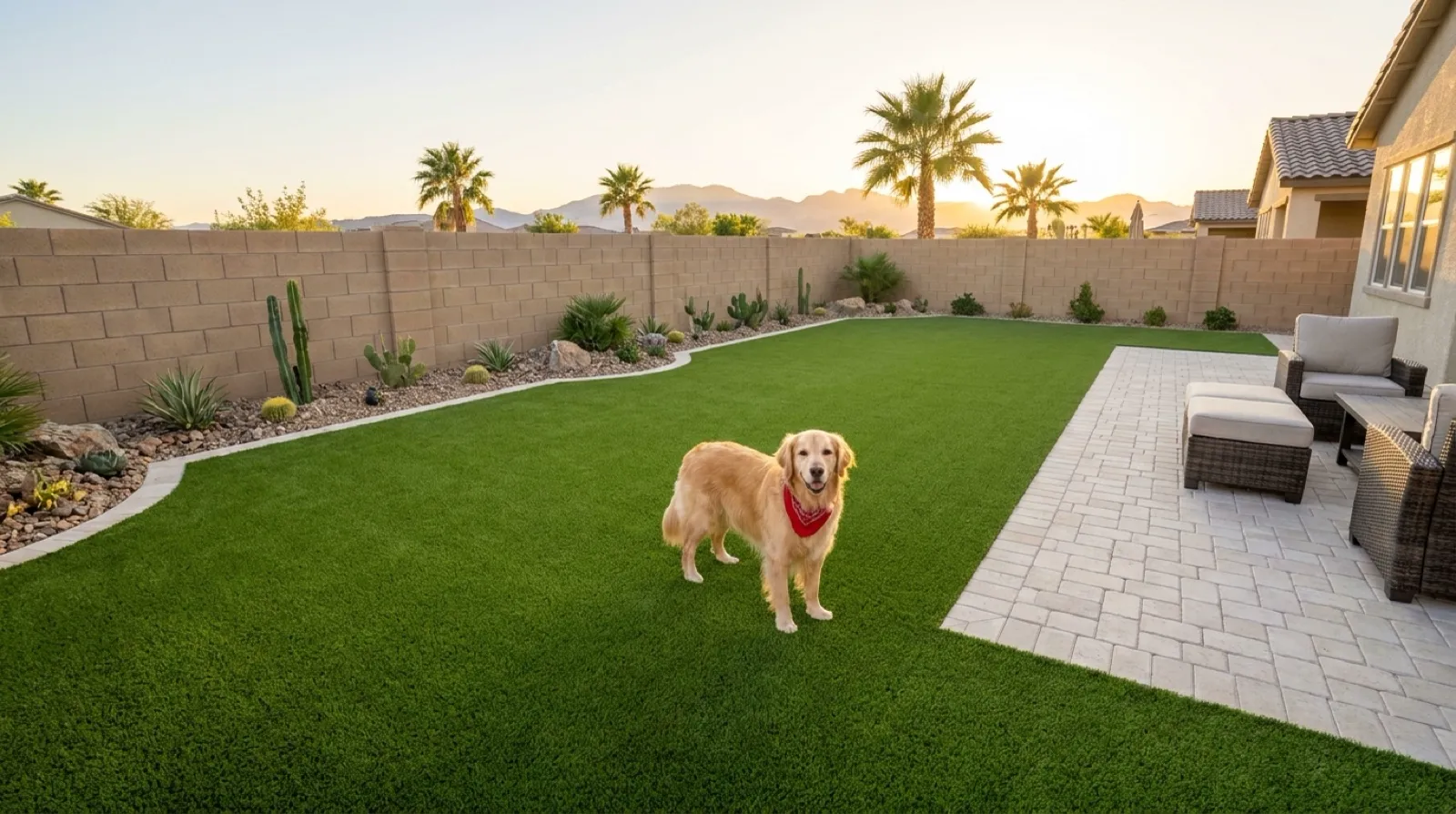
This is the hardest case in the valley and it is also the most common. Turf has no soil, so nothing is breaking anything down. Urine passes through the blades into the infill and then into the backing, and it stays in that layer indefinitely. Heat pushes the smell back up. A turf yard with multiple dogs can look immaculate and be the worst smelling yard on the block. The post on dog poop on artificial turf in Las Vegas covers the surface more broadly, including what to look for before you install it.
Landscape rock and gravel
Urine runs straight through the stones and into the soil or weed barrier below, and it takes some of the residue on the stones with it. That underlayer stays damper than the surface and gets no sun, which is exactly the condition that keeps odor going. Rock also has an enormous amount of surface area for residue to cling to.
Concrete, pavers, and block walls
Porous hard surfaces absorb it and hold it in the pores and joints. Block walls matter more than people expect, because male dogs mark vertical surfaces by preference, so the base of the wall often carries more concentration than the middle of the yard does.
Real grass and soil
The mildest case, because soil has biological activity working on it. The visible problem here is usually spotting and dead patches from nitrogen rather than a persistent smell, though a heavily used area in a small yard can still get saturated.
Why Hosing Spreads It Instead of Removing It
Hosing the yard is what nearly everyone tries first, and it is close to the worst thing you can do for urine odor.
Water does not lift urine out of a surface. It dilutes it and carries it further, which means more square footage affected rather than less. On turf it pushes residue deeper into the infill and backing. On rock it carries it down toward the soil layer where the sun cannot reach it. On concrete it moves it into the joints and along the slope.
It also frequently makes the smell worse for a day or two, because rehydrating dried residue makes it active again. If you have ever hosed the yard down and thought it smelled stronger that evening, that is what happened.
Bleach is the other common instinct and it is also a bad trade. It damages surfaces, harms nearby plants and drip lines, does not reach the layer holding the odor, and puts runoff into your own soil.
What Sanitizing Actually Addresses
The thing that works on urine odor is a treatment applied to the surface that addresses the residue and the bacteria contributing to the smell, rather than a rinse that moves material around. That is what our deodorizing and sanitizing service does, and it is worth being precise about the claim.
What it does: reduces the bacteria and odor load on the surfaces it reaches, treats the areas where dogs actually go rather than the whole property indiscriminately, and gets a yard back to the point where you can be out there in the afternoon without noticing it.
What it does not do: sterilize a yard. Nobody can promise that and you should be skeptical of anyone who does. A yard is an open outdoor environment with dogs living in it. Deep saturation in turf backing that has been building for years may need more than one pass, and heavily used areas will need treatment again as they get used again.
Being honest about that is not a hedge. It is the difference between a treatment that works and a claim that sets you up to be disappointed.
How Often a Urine-Heavy Yard Needs Treatment
Frequency depends on three things: how many dogs use the yard, how concentrated their habits are, and what the surface is.
- Multiple dogs on artificial turf. The heaviest case, especially in summer. These yards generally need treatment on a regular cycle rather than once, because the infill keeps taking on new material.
- One dog on turf or a small walled yard. Usually manageable with periodic treatment, since the volume is lower and it stays in a narrower area.
- Rock or grass with a single dog on a larger lot. Often needs treatment far less often, and sometimes just after a season where the yard fell behind.
- Any yard with a marked wall line. The base of the wall usually needs attention even when the open ground is fine.
Rather than guess, the practical move is to get the removal side priced and handled first, then decide about treatment based on what the yard smells like once it is genuinely clear. The quote form covers the scooping side in about a minute, and treatment can be added on when it makes sense for your surfaces.
Scooping Plus Sanitizing, in That Order
The order is not arbitrary. Treat a yard that still has solid waste in it and you have wasted the treatment, because the source is still there and the material is still arriving.
Clear the yard first, and keep it clear on a schedule so it is not accumulating between visits. Then treat the surfaces that are holding the urine, focusing on the areas the dogs actually use. Then keep the routine going, because a yard on a consistent schedule holds its baseline while a yard that gets one heroic cleanup drifts right back.
Scooping handles what you can see. Sanitizing handles what soaked in. Neither one substitutes for the other, and the yards that smell the worst are almost always the ones where somebody has been doing the first half faithfully and wondering why it did not work.
Service runs Monday through Friday, there are no contracts, and every visit ends with photo proof of the finished yard and the latched gate sent to your phone.
If the yard is clean and it still smells, the removal was never the missing piece. Get your price in about 60 seconds, or call or text (725) 200-2028 Monday through Friday and tell me what surface you are dealing with.
Get my free quoteDog Urine Odor Questions From Las Vegas Yards
Why does my yard smell like urine after I pick up the poop?
Because scooping only removes solid waste. Urine is already down in the turf infill, the rock layer, or the concrete.
Does hosing get rid of dog pee smell?
No. It dilutes and spreads it, pushes it deeper, and often makes the smell stronger for a day or two.
Why is it worse on artificial turf?
No soil, no breakdown. Urine sits in the infill and backing, and heat pushes the smell back up.
How often does a urine heavy yard need treatment?
Multi dog turf yards usually need a regular cycle. A single dog on a larger rock or grass yard often needs it much less.
Can sanitizing remove all the bacteria?
No. It reduces the load on the surfaces it reaches. Anyone promising a sterile yard is overselling it.
On artificial turf specifically, the odor usually lives under the blades. Artificial turf drainage and dog urine covers infill types, low spots, and why rinsing stops working. If the damp patch is always in the same place, check the watering: dogs and drip irrigation covers the leaking emitter that keeps one corner wet all week.
This guide keeps telling you not to reach for the hose, so here is the reason in full: hosing down a dog yard in Las Vegas and the water rules covers what is actually restricted here and what runoff into the street gets you.
Want your exact monthly price for this yard? The quote form takes about 60 seconds.
Get my free quote