Quick answer
What does a pooper scooper service include?
A full walk of the yard on a set weekday, covering the perimeter and wall lines, side yards, planter beds, behind structures, shaded areas, and hard surfaces. All dog waste found is double bagged into your own bin on the property, the gate gets latched, and a photo of the cleared yard and closed gate goes to your phone. Las Vegas service runs Monday to Friday.
Most people asking what a pooper scooper service includes have never hired one, and the websites are not much help because they all say the same three vague things. So here is the unglamorous version: a real dog waste removal visit in Las Vegas, start to finish, including the parts nobody puts on a services page.
If you are still deciding whether to hire anyone at all, the post on choosing a pooper scooper in Las Vegas is the better starting point. This one assumes you are close and want to know what actually happens at your gate.
Before the visit: scheduling and gate access
You get a set weekday, and it stays the same week to week. Service runs Monday to Friday. Having a fixed day is not a small detail, it is most of the value: you know when the yard gets cleared, and you can plan around it, whether that is trash pickup day or having people over.
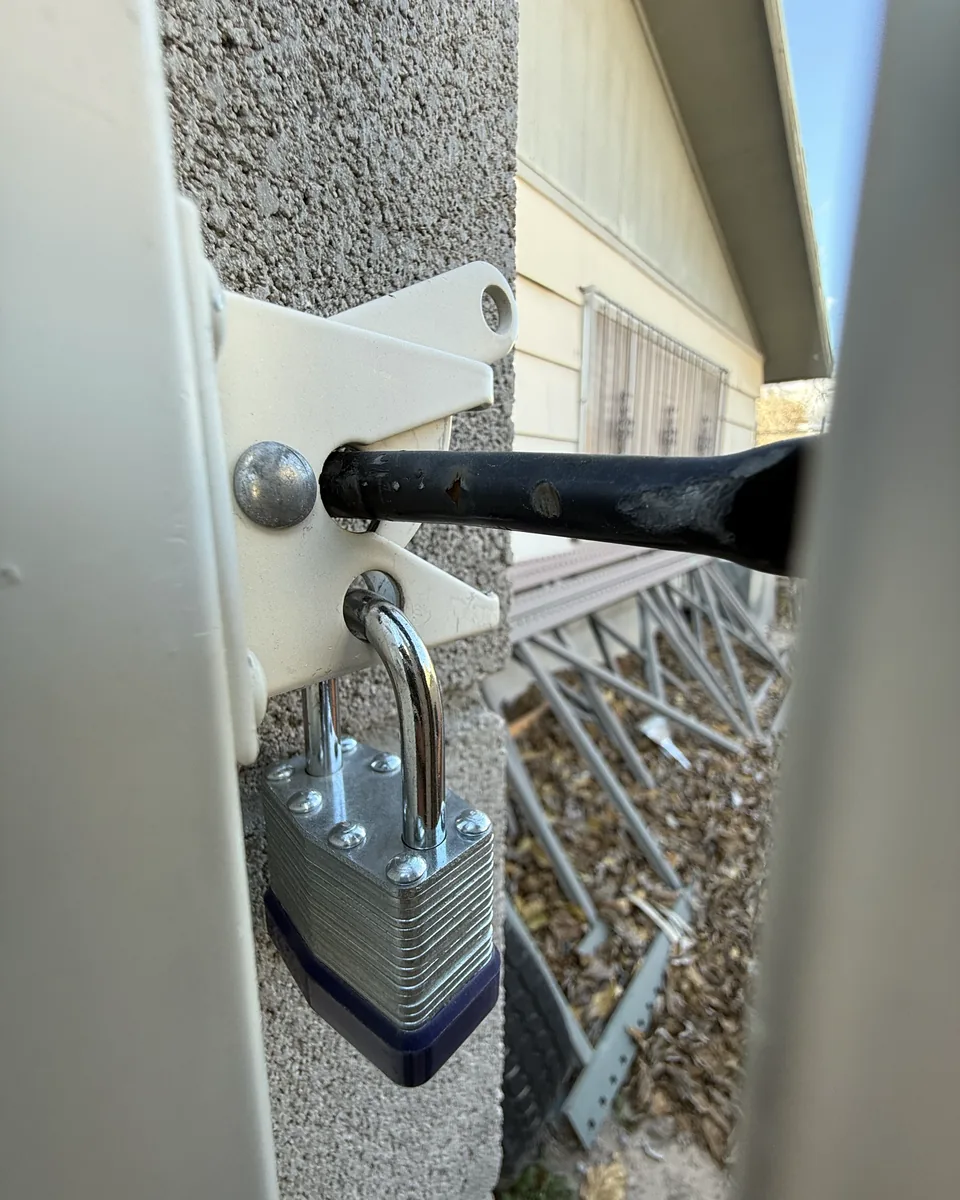
Access is the thing that trips people up before their first visit, and it is simpler than they expect. There are three normal setups:
- An unlocked side gate. The most common. You leave it unlocked on your service day and that is the entire arrangement.
- A combination lock or gate code. Very common in HOA neighborhoods and gated communities. You share the code once at signup and it lives in the route notes.
- Guard gate check in. Standard in some Henderson and Summerlin communities. Add us to your approved list and the process runs itself.
The other thing to settle up front is your dog. Most dogs are fine and stay out during the visit, and honestly a lot of them treat it as the highlight of their week. If your dog is anxious, reactive, protective of the yard, or likely to bolt through an open gate, say so at signup and we will keep them inside during the visit window instead. Nobody wants to find out the hard way.
You do not need to be home. That is the answer to the most common question in this whole category, and it is covered in more detail on the do I need to be home FAQ.
The walk: how a yard actually gets covered
A yard does not get cleaned by walking around the open middle looking down. It gets cleaned by covering the whole footprint in a deliberate pattern, because dogs do not use the middle. Dogs use edges, corners, shade, and the places you cannot see from the patio door.
The areas that get covered every visit:
- The full perimeter and wall lines. Wind pushes dried material against block walls, and dogs favor the boundary of a space.
- Side yards. Narrow, often forgotten, and frequently where the dog goes when the main yard is hot.
- Planter beds and around shrubs. Mulch, ground cover, and low branches all hide waste effectively.
- Behind and beside structures. Sheds, AC units, storage benches, play sets.
- Shaded areas. Where dogs go in summer, and where material stays soft longest.
- The open areas. Which is the part everyone thinks of.
Sun angle matters more than you would think. Dried waste on rock in flat midday light is genuinely hard to see, so the walk gets done from more than one direction rather than in a single lap. That is the difference between a yard that is clear and a yard that looks clear from the door.
If the yard has a slope, the low end and any wash area get extra attention, because that is where material ends up after rain or watering.
Surfaces: grass, turf, rock, and concrete
Four surfaces, four different jobs. Most Las Vegas yards have at least three of them.
Grass
The easiest surface. Waste lifts cleanly if it has not been sitting long. The care is in not leaving residue behind on the blades, and in checking the thatch layer where things settle.
Artificial turf
Solids come up easily. The issue is what has already gone down into the infill, which scooping does not reach. Turf yards stay clean with frequent removal, and if there is an existing odor history they usually need sanitizing as a separate treatment.
Decorative rock and gravel
The slowest surface and the one that separates a careful visit from a fast one. Dried waste breaks apart and drops between stones. The technique is careful removal with minimal disturbance of the rock, because raking spreads material and hosing pushes it deeper. This takes longer per square foot than grass, and it should.
Concrete and pavers
Patios and walkways get cleared every visit because they are the surfaces people actually stand on. Porous concrete holds odor after the mess is gone, which is a treatment issue rather than a scooping issue.
The full service breakdown, including sanitizing, is on the services page. If you already know what you need, the instant quote takes about a minute.
Where the waste goes
Straight answer: into your own trash bin, on your property, double bagged.
That is how residential pet waste is handled here. It does not leave with me, it does not go into a truck, and it does not get stashed somewhere in the yard. Double bagging matters because a leaking bag in a hot Las Vegas bin is what creates a lasting odor problem, and that is a problem worth not creating.
If you tell me your pickup day, I will note it, and where the route allows your visit sits near it so the bag is not sitting in a hot bin for a week.
One related note: dog waste belongs in the regular household trash. Not green waste, not recycling, and not a home compost pile, which does not reach the temperatures needed to handle it safely in a backyard setting.
The photo proof and the notification
At the end of every visit, before I leave, I latch the gate, photograph the cleared yard and the closed gate, and send it to your phone.
You are buying a service performed in a place you are usually not, while you are usually not there. That is an unusual arrangement, and the only thing standing between it and a leap of faith is evidence. Without a photo, the honest position is that you do not know whether anyone came, and the only way to check is to go look at the yard yourself, which is a chore you were trying to eliminate.
The closed gate in the frame is not decoration either. An open gate is the one genuinely serious mistake in this line of work, and photographing it means it gets confirmed on every single visit rather than assumed.
What happens if something is off, and what is not included
Things occasionally go sideways. Here is how each case is handled.
The gate is locked or blocked. You get a message before I leave, so you know why the visit did not happen rather than finding out later.
A dog is out and clearly not comfortable with a stranger. I do not force it. You get a message and we sort out a plan.
You think something got missed. Reply to the photo message and tell me what you are seeing. If it got missed, it gets fixed. The photo exists so that conversation is about the yard, not about whether anyone showed up.
Weather. Storms happen, and occasionally a visit shifts. You get told rather than left wondering.
What is not included, so there are no surprises:
- Landscaping. No mowing, trimming, weeding, or leaf cleanup. This is waste removal.
- Waste removal from the property. It goes in your bin, as above.
- Sanitizing by default. Odor treatment for turf, concrete, and patios is a separate add on, because not every yard needs it.
- Indoor anything. Yard and hard surfaces only.
- Visits outside the service week. Service days are Monday to Friday.
Common questions
Do I need to be home?
No. Most customers are not. An accessible gate or a code is all that is needed.
Can my dog be outside?
Usually yes. If your dog is anxious or a runner, keep them in during the visit window and let us know at signup.
Is the same person coming every week?
Yes. Your yard is assigned to a route rather than a dispatch pool, so you get the same team every visit.
What if my yard has not been cleaned in months?
That is normal and it is not a problem. A one time cleanup resets it, then the routine keeps it that way.
Am I locked into a contract?
No. Change frequency, pause, or stop whenever you want.
The quote asks three things: how many dogs, how big the yard, and how often you want service. You get a real number, not a callback. Get your Las Vegas quote, or call or text (725) 200-2028 with anything this page did not answer.
Two follow-ups: the three ways to hire a scooper here, which decides who is actually at your gate, and yard help for seniors in Las Vegas if you are setting this up for a parent.
Buying this for somebody else rather than for yourself? Gifting a pooper scooper service in Las Vegas covers how to arrange it when you have never seen their yard.
Three questions come up so often that each one now has its own guide: what the first 30 days look like after you book, how a scooper actually gets into a locked backyard, and whether your dog can be outside during the visit.
What happens after the visit, out at the curb, is its own question. Cleaning tools between yards covers the routine between one property and the next, and why waste from your yard never leaves your property.
Want your exact monthly price for this yard? The quote form takes about 60 seconds.
Get my free quote