
Quick answer
How do you keep neighborhood cats out of a gravel yard?
Make the yard less useful to a cat rather than trying to chase one off. Take away outdoor food and water, close off the gaps under sheds and equipment, and pay attention to the quiet, soft, shaded corners where cats prefer to go. Loose decomposed granite is the draw in most Las Vegas yards, because it behaves almost exactly like litter.
"Neighborhood cats pooping in my yard" is one of the most common yard complaints in this valley, and the reason is sitting right there under everybody's feet. Rock landscaping is the default here, and to a cat, loose decomposed granite is not landscaping. It is a very large litter box that somebody thoughtfully left unattended.
This post is about what is actually going on and what genuinely changes it. It is not about getting rid of an animal, and I am not going to recommend a spray, a device, a plant or a trap.
Why a desert yard is a magnet
A Las Vegas backyard offers a cat almost everything it wants in one place, which is why this happens so often here and so much less in places with lawns.
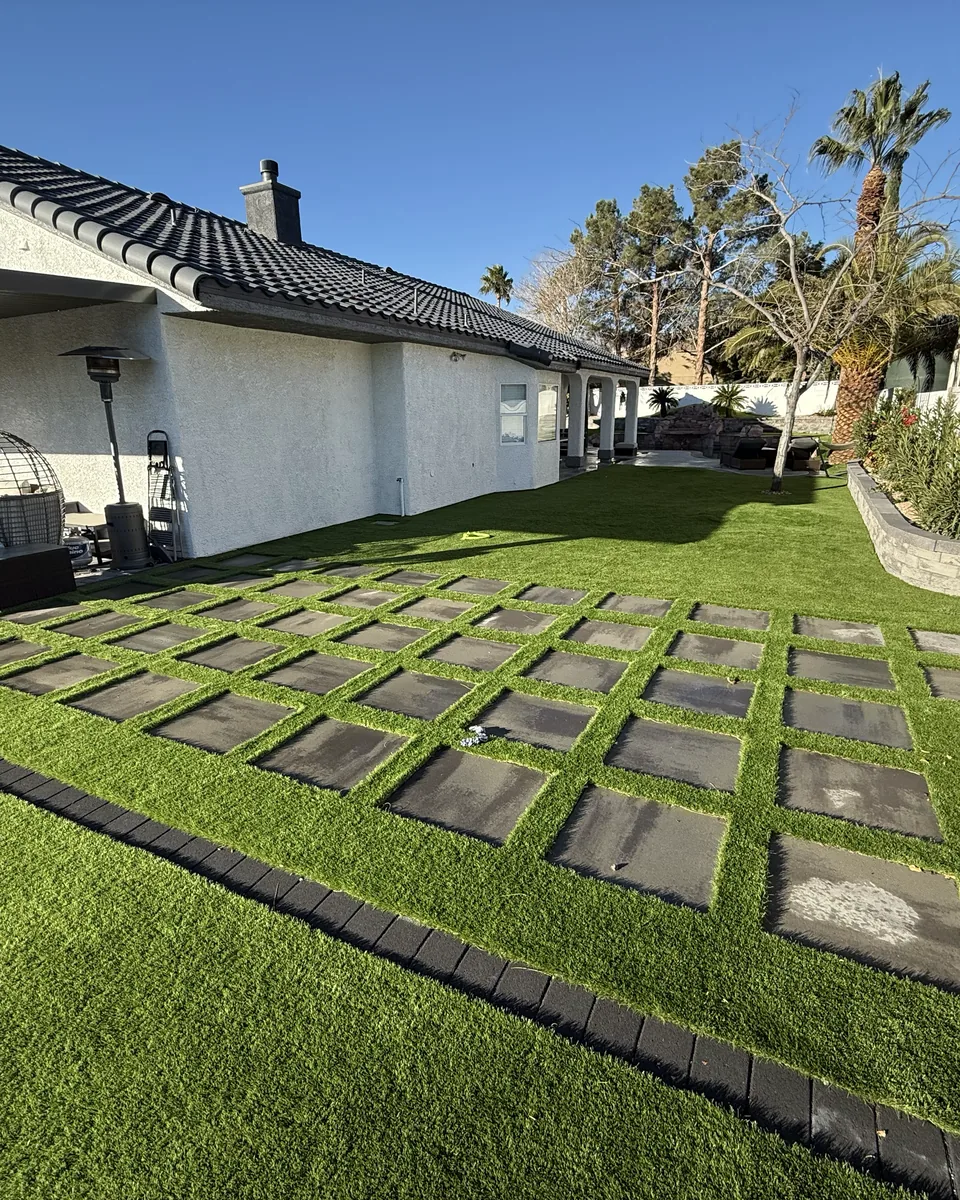
Cats look for ground that is dry, loose enough to dig, easy to cover, and out of the line of sight. A desert yard is dry by definition, the ground cover is loose by design, it drains after any rain within the hour, and the perimeter of a walled lot is full of quiet corners nobody walks through.
Add block walls on every side, which double as a highway between properties, and the number of cats with easy access to your yard is much larger than the number of cats you have ever seen in it.
Loose gravel, decomposed granite, and the litter box problem
The ground cover is the single biggest factor, and it is worth understanding before you spend money on anything else.
Fine, loose decomposed granite is the closest thing in a hardware store to commercial cat litter. It is small, dry, movable with a paw, and it covers. Larger, heavier rock is less appealing for the same reason a bowl of marbles would be: a cat cannot work with it. Compacted or stabilized decomposed granite sits somewhere in the middle, and it gets less attractive the more compacted it is.
None of that means you should rip out your yard over a cat. It does mean that if you are already planning ground cover work, the choice you make will change how often this happens. The full comparison of materials, including how each one behaves under a dog, is in the guide to decomposed granite and pea gravel as dog yard ground cover.
Where cats choose: soft, dry, and out of sight
Cats do not use the middle of your yard. They use the edges, and they use them consistently.
The spots that come up over and over:
- Behind the shed, the air conditioning unit, or the pool equipment.
- Along the base of the block wall, especially where a shrub or a planter gives cover.
- Under low bushes and against the fence line.
- Raised planters and any bed with loose, soft, dry soil in it.
- A children's sandbox that does not get covered.
If that list sounds familiar, it is because those are the same spots dog waste hides in, for related reasons: cover, shade and privacy. The point of knowing the list is that you stop searching your whole yard and start checking six places.
What discourages them, and what does not
What works is removing the reasons a cat is there in the first place. What does not work, reliably, is most of what is sold to homeowners for this.
The moves that actually change something
- No food outside. Not for your pets, not for the birds in a way that spills, not for the cats. Somebody within a couple of houses is probably feeding them, and that is the strongest draw on the block.
- No water outside beyond what your own animals need while they are out. In this climate a standing water source is a serious attraction.
- Close the gaps. Under the shed, under a deck, behind the equipment, into an open crawl space. Shelter matters as much as ground does.
- Cover the soft spots. A lid on the sandbox, and something over open beds where you can manage it.
- Use the yard. A yard with a dog in it regularly, with people out there, with the ground disturbed by an actual routine, is a lower value site than a quiet one.
- Keep it cleared. Waste of any kind sitting out there is a signal that a yard is unmanaged, and it also makes it far harder to tell what is new.
What I am not going to tell you to do
I am not naming a repellent, a spray, a granule, a device or a plant. Some of them are ineffective, some of them are a bad idea around dogs and children, and I have no way to verify a claim on the back of a box for your yard. If you want to try something, ask your vet whether it is a problem to have around your dog before it goes into the ground.
And nothing gets done to the animal. Do not trap, do not relocate, do not use anything intended to hurt a cat. Aside from the obvious, it is a good way to end up in a dispute with a neighbor or with an agency.
Why it matters more when you have a dog or small kids
It matters because a dog investigates the yard with its nose and a small child investigates it with their hands, and neither of them is going to skip the corner behind the shed.
What can actually be carried in waste, cat or dog, is a health question and it belongs to a professional. Ask your veterinarian about anything to do with your dog and ask your doctor or your child's pediatrician about anything to do with a person. The one place this blog has already covered the overlap is in the post on yard safety for pregnant dog owners, which sorts out the confusion people carry about cats specifically. It is worth reading if that is the situation you are in, and I am not going to restate it here.
For the version of this that concerns children playing on the ground, the post on roundworms and kids playing in the yard covers the yard side without pretending to be medical advice.
The practical takeaway is unglamorous: whatever is out there, the less time it spends out there, the better. If clearing the yard consistently is the part that is not happening, you can get a quote in about a minute.
Who to call about a colony
If you are dealing with a group of free roaming cats rather than one visitor, that is a community problem and there is a proper channel for it.
Start with the animal services agency for your city or for Clark County, depending on where you live, and ask how they handle free roaming cats in your area. The valley also has nonprofits that run trap, neuter and return programs, and in many neighborhoods that is the route that actually reduces the population over time. I am not naming an organisation here, because the right one depends on where you are and because contact details change.
If the animal has an owner and the issue is a pet coming over the wall rather than a stray, that is a neighbor conversation, and the approach that keeps it from turning into a feud is covered in the post on a neighbor's animal leaving waste in your yard. Worth reading before you knock on a door, because a good share of "the neighbor's dog is doing this" turns out to be a cat, and a good share of "it must be a cat" turns out to be something else again, including the rodent side of a Vegas yard.
What a scooping service covers with cats in the picture
Cat waste in the yard gets scooped. If I am walking your yard and there is cat waste in it, it goes in the bag with the rest of it, and there is no separate charge for that. I am not going to walk past something and leave it there because a cat left it.
What is not part of this is cat litter and litter boxes. Litter boxes are indoor work, they are not a yard job, and they are not something I take on. That line stays where it is.
The rest of the regular service is what you would expect: a fixed weekday, the whole yard walked including the corners this post has been talking about, waste bagged and put into your own trash bin on site, and a photo of the cleared yard afterward so you can see the spots you cannot see from the patio. What is included in a visit is set out on the services page.
If the cat situation is the thing that finally made you look at getting the yard handled, get a quote for regular cleanup. It takes about a minute, service runs Monday to Friday, and you can ask any scope question directly when you do it. Questions first? Call or text (725) 200-2028.
Want your exact monthly price for this yard? The quote form takes about 60 seconds.
Get my free quote