
Quick answer
How long does dog poop take to decompose in the desert?
Far longer than most owners assume, and in a Las Vegas yard what looks like decomposing is usually just drying. Real breakdown needs moisture and active soil life, and bare rock in full summer sun supplies almost none of that. Anybody who hands you a confident number for this is guessing, because it depends entirely on where in the yard it landed.
How long does dog poop take to decompose is one of the most searched questions in this whole subject, and almost every answer online was written for somewhere with a lawn, rain and soil that is alive. Las Vegas is none of those things, so the honest local answer is different.
Two neighbors to this post, so you know what you are reading. Whether you can compost it here is covered in the post on composting dog waste in the desert. Whether the heat sterilizes your yard is covered in the post on dog waste and Las Vegas summer heat. This one is about what physically happens to waste that is left outside here.
The short answer for a desert yard
Long enough that leaving it is never the plan, and I am not going to print a number.
That is not evasion. It is the only defensible position. The rate depends on where in the yard it landed, how much sun that spot gets, whether irrigation reaches it, what the ground cover is, what time of year it is, and what the dog has been eating. Two piles ten feet apart in the same yard can be in completely different situations, and a number pulled off a national blog post has no relationship to your side yard.
What is worth knowing is not a timeline. It is what actually happens, because that is what tells you why waiting does not work.
Drying out is not the same as breaking down
These are two different processes and the desert only really does one of them.
Breaking down is biological. It needs moisture, it needs soil organisms doing the work, and it needs conditions that let that continue over time. That is what happens in a compost pile and, more slowly, in a lawn.
Drying out is physical. Water leaves, the material hardens, the color changes, the volume looks smaller. Nothing has been resolved. It just looks resolved from the patio door, which is exactly why so many Vegas owners believe their yard handles itself.
The clearest way to see the difference is what happens the first time that dried material gets wet again, from a monsoon storm, a hose, or an irrigation zone that overshoots. The smell comes straight back. That is not a decomposed pile behaving oddly. That is an intact pile that was only dehydrated.
What the sun does, and what it does not
Direct sun in a Las Vegas summer works on the surface of anything left outside, and it works fast.
What that gets you is a crust and then a hardened mass. It changes how it handles: harder to smear, more likely to fragment when you try to lift it, more likely to leave pieces behind on rock. Every owner here has picked one up and had it come apart.
What it does not get you is a clean yard, and it does not get you the sterilization people are hoping for. That specific question is answered properly on the summer heat post linked above, so I will leave it there rather than half answering it here.
And the sun is not on all of it. Every yard in the valley has shaded ground: the side yard, the base of a north facing wall, under a shrub, behind the shed. Those spots hold moisture longer and behave nothing like the open middle of the yard. They are also where dogs prefer to go, which is a coincidence nobody enjoys.
Where it goes when it turns to dust
It does not leave the property. It gets smaller and it gets into the ground cover.
Hardened material fragments. Foot traffic, a dog running over it, a rake, a leaf blower, the spring wind: all of it breaks the pieces down further. Those pieces work into the gaps between rocks, into the top layer of decomposed granite, and into turf infill. From five feet away the yard looks clear. Up close, and especially on your hands and knees with a child or a dog, it is not.
That is the part that matters most and it is the part almost nobody says out loud: waste in a desert yard does not vanish, it disperses. Dispersed material is harder to remove than a whole pile, which is the argument for getting to it while it is still one object.
Wind moves the fine end of that around the yard and beyond it, which is a plain physical statement and not a health claim. I am not going to tell you what it does to anybody's lungs, because that is not my field and any number I printed would be invented.
If your yard is already past the point where individual pieces are the problem, that is what a full clearing is for. You can get a quote in about a minute.
Rock, turf, and grass each hold it differently
Same waste, three completely different outcomes, which is why generic advice on this fails locally.
Rock and decomposed granite
The worst case for fragmenting. Loose stone has gaps and everything small ends up in them. Dried material breaks apart exactly when you are trying to lift it, so a late pickup on rock always leaves more behind than a prompt one. Technique matters here and it is covered in detail in the guide to cleaning dog waste out of rock landscaping.
Artificial turf
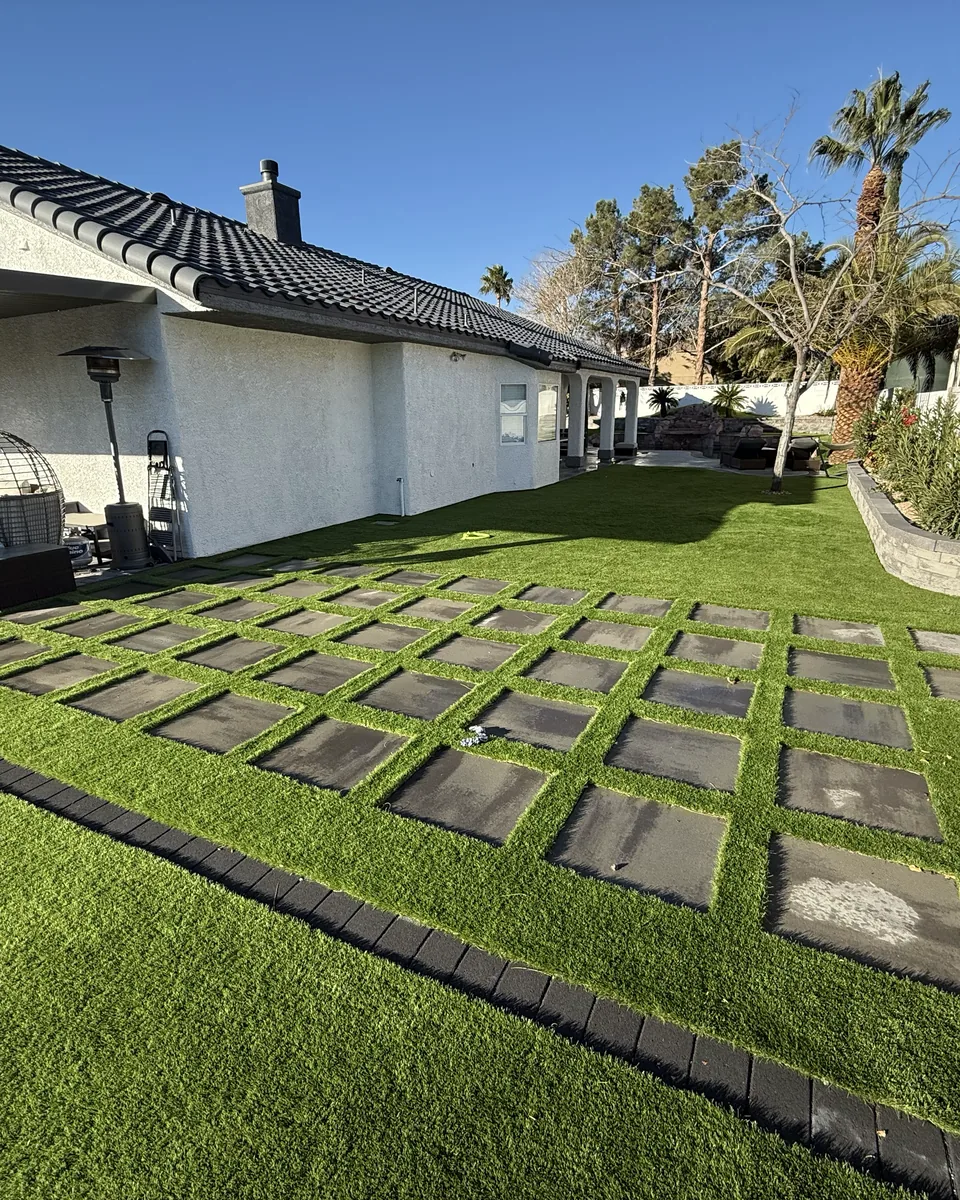
Turf looks like the easy surface and mostly is, until something soft gets into the infill or something dried fragments down between the blades. Turf also holds odor rather than hiding it, because there is no soil under there doing anything with it.
Real grass
Grass is the only surface in a Vegas yard with a living soil layer under it, so it is the only one where genuine breakdown happens at any meaningful rate. That is not permission to leave it. Watered grass keeps the material soft, which is worse for pickup and worse for the lawn itself.
Why "it will go away on its own" is the expensive answer
Because what actually happens is that it stops being visible while staying in your yard, and the bill arrives later in a different form.
The later form is odor that comes back with the first water, a rock yard that needs a full reset instead of a routine visit, turf that holds smell in the infill, and a yard where you can no longer tell what is new. Owners who let it ride through a summer usually end up paying for a one time clearing that would not have been necessary if the routine had held.
There is also the simple fact that the middle of the yard is not where the problem lives. The spots that get missed are structural, seasonal and predictable, and they are covered in the companion post on where dog waste hides in a Vegas yard.
The alternative is unremarkable and works: a fixed weekday, the whole yard walked, waste bagged into your own bin on site, and a photo afterward. That is what is on the services page, and it is the version where nothing gets a chance to dry into the ground in the first place.
Get a quote for regular yard cleanup. It takes about a minute and service runs Monday to Friday. Questions first? Call or text (725) 200-2028.
Want your exact monthly price for this yard? The quote form takes about 60 seconds.
Get my free quote