
Quick answer
How does pet waste removal work at a senior living community?
It runs as a scheduled grounds service rather than a resident by resident arrangement. A routine covers the shared areas a Las Vegas community agrees on, on set weekdays, with waste going into the property's own bins on site and photos of the finished areas sent afterward. The exact scope gets settled in the proposal.
Senior living community pet waste removal is a grounds problem that most properties inherit rather than plan for. Pet friendly policies are close to standard now, residents keep the dog they had before they moved in, and the community ends up owning an outcome that its own rules assign to somebody else. This post is written for whoever actually carries that: an executive director, a grounds and maintenance director, or the person who fields the complaint when the entrance walk is not right.
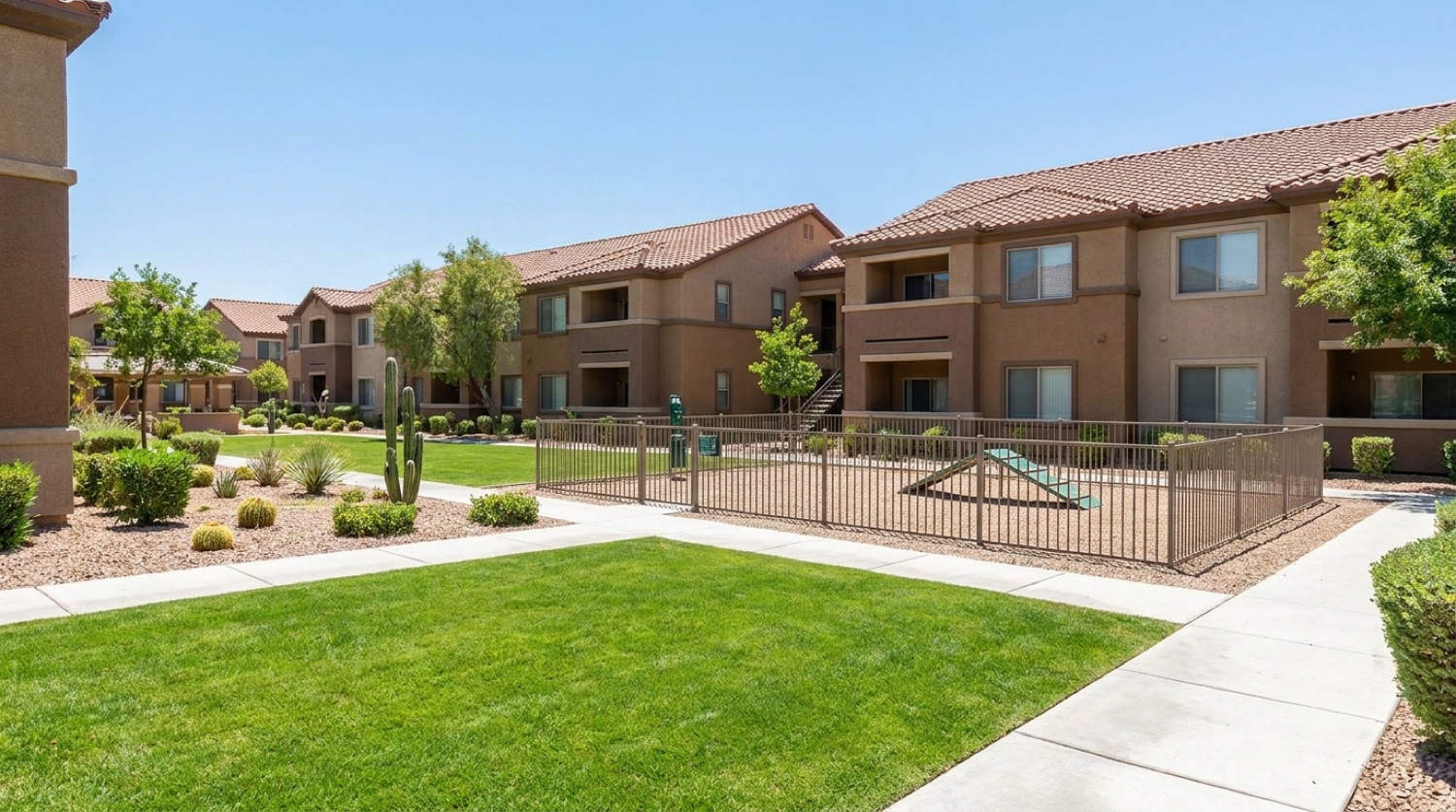
Two neighbors worth naming so you can go straight to the right page. If you run an apartment community, the live post on apartment pet waste removal is written for that. If you sit on a homeowners association board and you are running a bid process, the live post on HOA pet waste service bids covers procurement.
Why a Pet Friendly Senior Community Is a Different Job
The difference is not the acreage and it is not the dog count. It is the gap between the rule and what is physically going to happen.
In an apartment community, a resident who does not pick up is usually choosing not to. Enforcement, signage and lease language all work on that person because the behavior is available to them.
On a senior campus, a meaningful share of the residents with dogs cannot do it, and no amount of signage changes that. Those two situations look identical on a walking path and they are completely different problems. Only one of them responds to a reminder in a newsletter.
That is the whole argument for treating it as a grounds line item. A property that keeps trying to solve it through resident communication is spending effort on the group that was never the issue, and getting frustrated that it is not working.
Residents Who Cannot Pick Up After Their Own Dog
Handle this one carefully, because it is a dignity issue before it is an operations issue.
The dog is often the single most important thing in a resident's day. It is company, it is a reason to go outside, and it is frequently the last piece of an independent life somebody is holding onto. Nobody wants to be the community that makes a resident choose between the dog and the rules, and the good communities know that.
So the practical move is to remove the conflict entirely rather than adjudicate it. If the grounds are covered on a routine, nobody has to be told anything, nobody is embarrassed, and staff never has to have the conversation that starts with a complaint from another resident. That is worth more to a community than the line item costs.
Shared Lawns, Relief Areas, and the Walk Everyone Uses
Coverage on a senior campus concentrates in a way it does not on other properties.
Residents with limited mobility do not walk the perimeter. They go out the nearest door, use the closest patch of grass or the nearest designated relief area, and come back. That means the pet waste on a senior campus is not spread across the property, it is stacked into a small number of high traffic spots, usually within sight of a building entrance or a common room window.
That concentration cuts both ways. It makes the job efficient, because the route is short and predictable. It also makes it visible, because the busiest spots are the ones every resident, every visitor and every prospective family walks past.
Getting the coverage map right is most of the work. Which lawns, which relief areas, which paths, which courtyards. Some of that is obvious on a walk and some of it only shows up when you ask the people who clean the entrance.
Stations: Placement, Supply, and Who Empties Them
Stations solve part of the problem for the residents who can use them, and they solve none of it for the residents who cannot. Worth being clear eyed about that before a property spends on them.
Where they go matters more than how many there are. A station placed for symmetry on a site plan, rather than on the path residents actually walk, does not get used. On a senior campus the useful placement is close to the doors people leave from and close to the relief areas that already exist by habit, not the ones the plan designated.
Supply and emptying are the part that quietly falls apart. An empty bag dispenser is worse than no dispenser, because it teaches everybody that the system does not work. The live post on dog waste stations in Las Vegas communities covers the product side in detail.
Who handles the stations on your property is part of the scope conversation. Ask when you request a proposal rather than assuming either way.
Odor Near the Entrance Is a Leasing Problem First
This is the argument that gets budget, so it is worth stating plainly.
A family touring a community for a parent is making an emotional decision under stress, and they read the grounds as a proxy for everything they cannot see. Nobody writes down what they noticed on the walk from the parking lot. They just leave with an impression.
In a Las Vegas summer, the entrance is exactly where that impression forms, because heat concentrates odor near hard surfaces and shaded corners, and the entrance has both. A relief area near a main door that has not been cleared in a few days is a leasing problem well before anybody would call it a hygiene one.
It is also one of the more fixable things on a property, because it is a routine rather than a capital project. Nothing has to be built, torn out or replaced.
Fitting a Route Around a Quiet Campus
Senior campuses have a rhythm and a good vendor works inside it rather than through it.
The same person shows up every visit, which matters on a property where residents notice a new face and where staff would rather not process a rotating cast of contractors. Visits are quiet and outdoor only. Waste is double bagged and goes into the property's own bins on site. Photos of the finished areas go to whoever manages the grounds, so nobody has to walk out and verify.
Service days are Monday through Friday. If your community has an event, a family day or a tour schedule you want the route timed around, say so and it gets built in.
If you want to see the commercial side laid out, the commercial service page covers it, and you can start a scope conversation from the quote form with your property details.
Getting a Proposal for Your Community
What is useful to have ready: the areas you want covered, a rough idea of how many dogs live on the property, where the relief areas are today, whether stations exist, and what the current complaint pattern looks like. That last one usually tells you more about the right frequency than the site plan does.
From there the scope and frequency get worked out honestly, including anything the property wants excluded.
Want the grounds handled so nobody has to have the conversation? Send your property details through the quote form, or call or text (725) 200-2028, Monday through Friday.
Request a proposalCommon Questions
How does pet waste removal work at a senior living community?
A scheduled grounds route on set weekdays, waste into the property's own bins on site, photos of the finished areas after each visit.
Who is responsible for picking up after residents' dogs in a retirement community?
The rules usually say the resident. In practice some residents cannot, which is why it lands on the grounds.
How often should a senior living community have its grounds cleared?
It follows the dog population, the relief area concentration and the foot traffic, not the acreage.
Do you supply and service pet waste stations?
Ask when you request a proposal. Placement is the part that decides whether stations work at all.
How do I get a proposal for pet waste removal at my community?
Send the property details, the dog population and the areas you want covered. Service days are Monday through Friday.
Want your exact monthly price for this yard? The quote form takes about 60 seconds.
Get my free quote