
Quick answer
What changes when a dog goes from an apartment to a house with a yard?
The biggest change is that the walk stops being mandatory. In an apartment the routine enforces itself, because somebody has to take the dog outside. A Las Vegas yard removes that forcing function, so the yard fills up quietly while everyone assumes somebody else is watching it. Set a spot and a checking habit in the first week.
Your first backyard with a dog feels like the finish line. No more elevator at six in the morning, no more standing in a shared grass strip in the dark, no more apologising to a neighbor for a bark. And it genuinely is better. But an apartment routine and a house routine are not the same routine, and in Las Vegas the difference shows up faster than most people expect, because the climate does not give you a long grace period.
If you moved here from another state, the live post on moving to Las Vegas with a dog covers the relocation side, the acclimation and the paperwork. This post is about the smaller and more specific jump from an apartment to a house, which is a different change even if you were already living here.
What Changes for the Dog on Day One
A yard is not just more space. It is unsupervised space, and that is a new category for a dog who has spent their life going outside with a human attached to them.
Some dogs take it instantly. They go out, they find shade, they lie down, and that is that. Others stand at the door and wait, because being outside on their own has never been a thing they were asked to do. Both are normal. A dog who hesitates is not broken.
Go out with them for the first stretch rather than opening the door and going back to unpacking. Let them walk the fence line with you. Let them find where the shade actually is at different times of day, because in this valley the shade moves and the good spot at nine in the morning is not the good spot at four in the afternoon.
The Habit You Have to Rebuild: From Walks to a Yard
Here is the part nobody warns you about.
In an apartment, the routine is enforced by the building. The dog needs out, so you go out, so you see everything the dog does, so you pick it up on the spot because you are standing right there and there is a trash can twenty steps away. The system runs itself and you never had to design it.
A house takes all of that away in one move. The dog goes out alone. You do not see it happen. There is no neighbor watching and no bin at the corner. Nothing in the day forces you to look at the yard, so the yard becomes something you deal with when it becomes a problem rather than something you deal with on a rhythm.
That is why yards get away from first time owners. It is not laziness. It is the removal of a forcing function that was doing the work invisibly for years.
Why a Yard Gets Away From First Time Owners
The pattern is predictable enough that I can usually tell a first yard from the phone call.
Week one, the yard is clear and everybody is thrilled. Week two, it is fine. Week three, there is a mental note. Week four, it is a job that takes real time, so it gets pushed to a day off, and then something else lands on that day. By week six it is not a chore anymore, it is a project, and projects get avoided in a way that chores do not.
The fix is to make it a rhythm before it becomes a project, and the live post on how often to pick up dog poop in Vegas gets specific about the frequency that actually holds here.
Desert Ground, Heat, and a Dog Who Has Never Had a Yard
A first Las Vegas yard usually comes with ground your dog has never stood on.
Rock and decomposed granite are the default here, and they behave differently from a lawn in two ways that matter. They hold heat, so a surface that looks harmless is not always comfortable in the afternoon. And they hide waste by color and by depth rather than by height, so instead of spotting something against green grass you are searching a surface that looks exactly like what you are searching for.
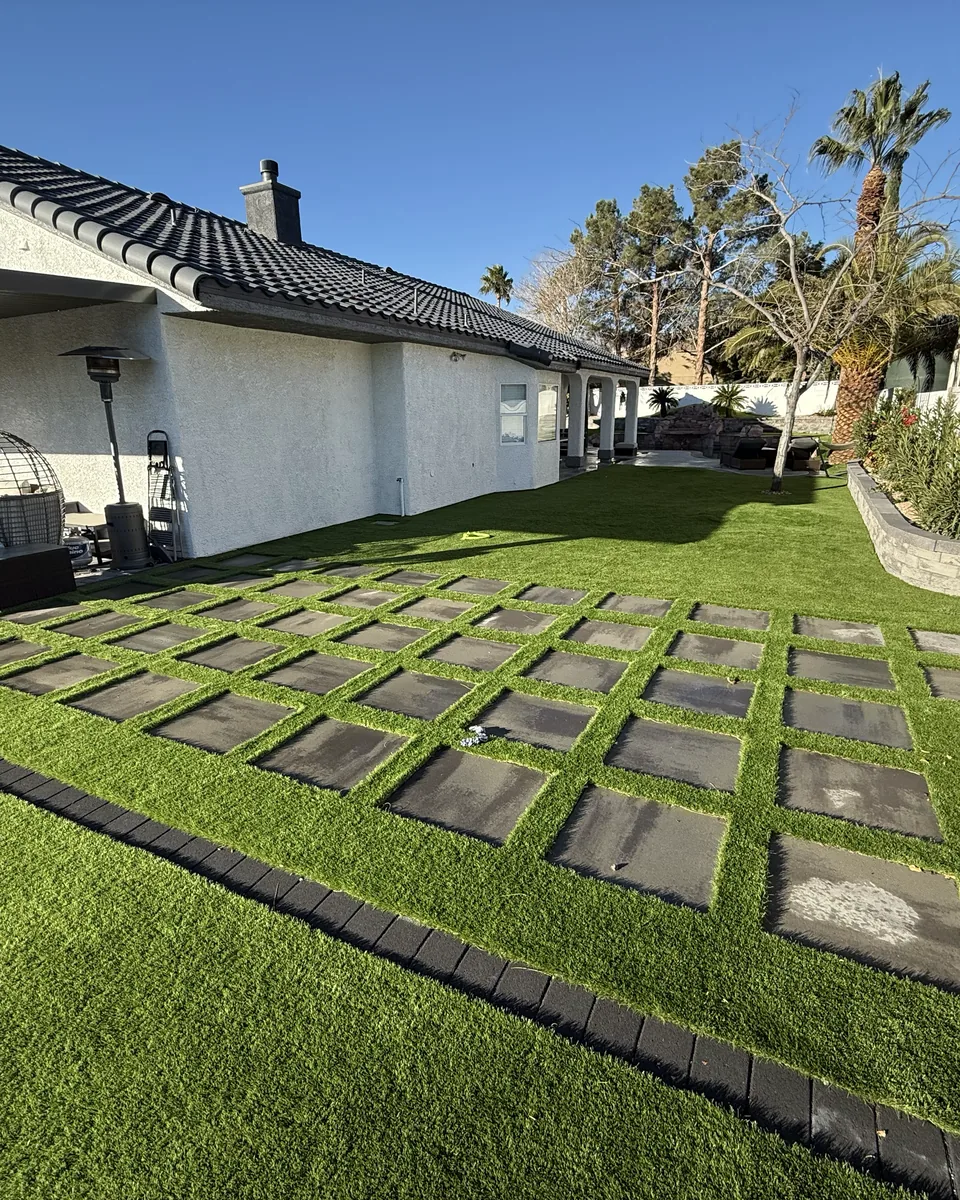
Turf has its own version of this. It looks clean at a glance and holds the residue at the base of the blades, which is why turf yards smell before they look bad.
None of that is a reason to dislike your yard. It is just a reason not to assume the cleanup will work the way it looked in whatever house you grew up in.
Setting a Spot and a Routine in Week One
Two things are much easier to establish now than to fix in six months.
The first is the spot. Most dogs pick one within days, usually somewhere with cover, along a wall, or at the far end from the door. Notice which one they picked and work with it. The live post on training a dog to poop in one spot walks through how to encourage it without a fight, and the short version is that reinforcing a choice they already made beats assigning one you prefer.
The second is your own checking habit. Pick a time that already exists in your day. Coffee, the trash going out, the last time you let the dog in for the night. Attaching it to something you already do is the entire trick, because a habit with no anchor does not survive a busy week.
What You Will Not Notice Until the First Hot Month
Summer is the exam.
Everything you did not stay on top of in spring is still in the yard, and heat changes what it does. Odor is stronger. Flies find it. The dog starts avoiding the part of the yard they used to use and picks a new spot, which is usually closer to the door and closer to the patio.
The other thing that changes is you. Nobody wants to walk a yard in the middle of a Las Vegas July afternoon, so the checking habit that was easy in March quietly dies in June, right at the moment the yard needs it most.
Knowing that in advance is most of the defense. Move your check to the early hours before it gets hot, and keep it short.
Deciding What You Are Actually Going to Do Yourself
This is worth being honest about early rather than discovering it in August.
Plenty of people do their own yard for years and are perfectly happy. If that is you, take the routine seriously and you will be fine. If you already know that this is the chore you are going to resent, there is no prize for finding out the hard way.
What it costs depends on how many dogs you have, how big the yard is and how often you want visits, which is all the pricing page is really about. If you would rather just see a number, the instant quote gives you one without a phone call and without anybody following up on you.
New house, new yard, and one less thing to figure out. Get an instant quote in about a minute, or call or text (725) 200-2028, Monday through Friday.
Get my instant quoteCommon Questions
What changes when a dog moves from an apartment to a house with a yard?
The walk stops being mandatory, which removes the routine that used to run itself. That is why first yards fill up faster than people expect.
How do I get my dog used to a backyard?
Go out with them at first, let them map the fence and the shade, and keep a walk in the schedule so the exercise does not disappear with the routine.
How often should I pick up dog poop in a Las Vegas backyard?
On a rhythm rather than when it looks bad. Cleared on a schedule it stays a yard, cleared on sight it becomes a project.
Is a rock yard harder to clean than grass?
Different, not harder. Rock hides waste by color and depth, so the searching takes longer even when the amount is the same.
Should I train my dog to use one spot in the yard?
It helps a lot on a small desert lot, and it is easier now than later. Reinforce the spot the dog already chose.
Want your exact monthly price for this yard? The quote form takes about 60 seconds.
Get my free quote