Quick answer
How do I stop my dog from eating poop?
Remove the opportunity. Prompt pickup is the step that does not depend on why your dog does it, because the behavior needs waste sitting in the yard to attach to, and a Las Vegas yard cleared once a week is available the other six days. Taste deterrents help some dogs and not others, and a sudden start in an adult dog is a vet call.
If you are asking why does my dog eat poop, you have probably already tried a product, a scolding, or a video that promised a trick. Here is the honest version. There are several real reasons dogs do it, most of the popular fixes work on some dogs and not others, and there is exactly one approach that works on every dog every time: there is nothing in the yard to find.
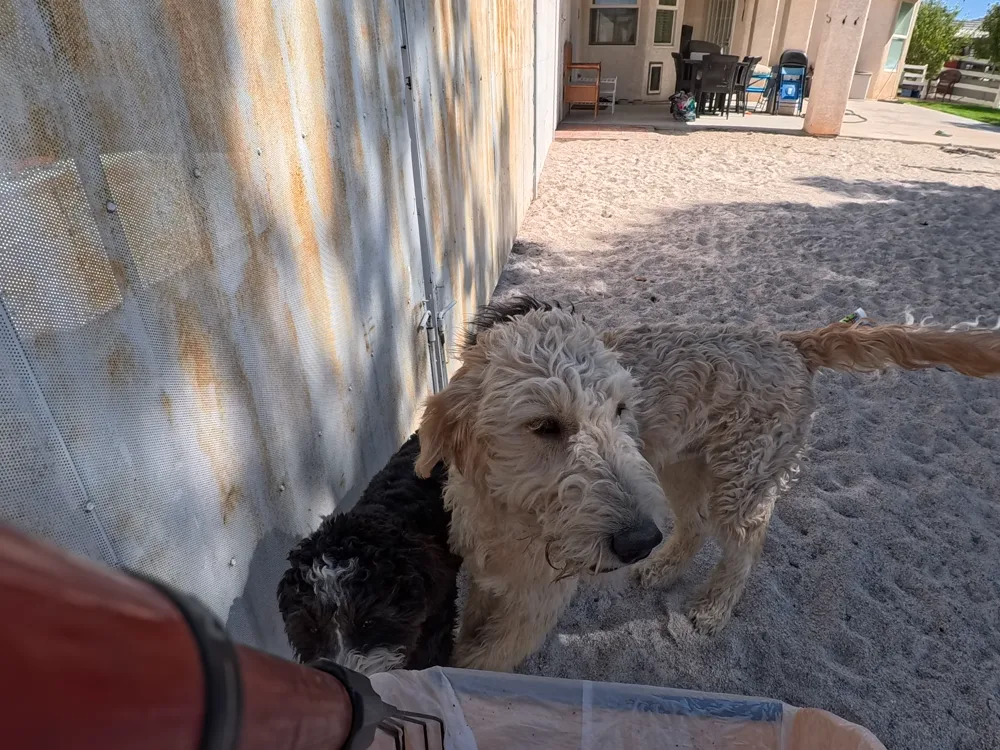
The common reasons dogs do it
The behavior has a name, coprophagia, and it is not rare or shameful. It shows up for a handful of reasons and it helps to know which one you are probably looking at.
- Puppy exploration. Puppies investigate the world with their mouths. Many of them do this for a stretch and then stop on their own.
- Learned from the mother. A mother dog cleans up after a litter as normal maternal behavior. Puppies watch that happen and some of them copy it.
- Boredom and understimulation. A dog alone in a yard with nothing to do will find something to do. This is one of the more common drivers in adult dogs.
- Attention seeking. If the behavior reliably produces a reaction from you, it has a payoff, even when the reaction is negative.
- Stress or anxiety. New home, new schedule, a new dog in the house, confinement. Stress behaviors show up in a lot of forms and this is one of them.
- Diet or a medical issue. This is the one you cannot troubleshoot from a blog post. Some dogs do it because something is off, and your vet is the person to sort that out.
Most dogs are somewhere in the first four. But you cannot tell from the outside which one you have, which is part of why the behavioral fixes are so inconsistent.
Why most deterrent products disappoint
The additives that are supposed to make stool taste unappealing are the standard first move, and plenty of owners have a friend who swears by them. They are worth trying. Just go in with realistic expectations.
Two problems come up. The first is that dogs vary, and a dog that is doing this out of boredom or habit is not making a flavor based decision in the first place. The second is coverage. In a multi dog household every dog has to be on the additive for the yard to be covered, and if one is not, the yard still has an option in it. The same coverage problem applies if your dog has access to a neighbor's yard, a park, or a shared common area.
Interrupting the behavior with training helps too, and it helps most when you are outside with the dog. The catch is that this mostly happens when you are not watching, which is exactly when training cannot reach it.
Talk to your vet if it is sudden
An adult dog that has never done this and suddenly starts is a different situation from a puppy that has always done it. Sudden onset is worth a vet call, and so is any version of this that comes with weight loss, appetite changes, or digestive trouble. Ask about parasite screening as well, since eating waste is one of the ways parasites move between dogs. None of this is veterinary advice, and the vet call is the right first step when something changed.
The one fix that works every time: nothing to find
Here is the part that does not depend on which reason applies to your dog. Every version of this behavior requires the same thing: waste sitting in the yard, available, for some length of time.
Take that away and the behavior has nothing to attach to. It is not a cure, and it is not a claim that the underlying reason disappears. A dog with a medical driver still has it, and a bored dog is still bored. But the opportunity is the one variable you control completely, and controlling it stops the practice from continuing while you work on the rest.
The important word is prompt. A yard cleaned once a week is available six days out of seven. If the behavior is active, the useful standard is picking up right away when you are home and keeping the gap short when you are not. That is a real change in routine for most households, and it is the reason people who have fought this for months finally get somewhere.
If you want the fuller picture on cadence, the guide on how often to pick up dog poop in Las Vegas covers what different households actually need. And if you would rather the yard just be handled on a set schedule instead of being one more thing on your list, the instant quote takes about a minute.
Multi-dog households make it harder
Two dogs is not twice the difficulty, it is more, and this behavior is one of the clearest examples of why.
More dogs means more waste in the same amount of ground, so the yard reaches an available state faster after every cleanup. It also means a dog may be eating another dog's waste rather than its own, which makes diet changes and additives much less effective unless every dog is covered. And parasite exposure runs higher when waste is moving between dogs in a shared space.
The multiple dogs yard guide gets into how the volume curve works and what frequency multi dog homes actually settle on. In a house where this behavior is active, more dogs almost always means a shorter interval between cleanups is required, not just preferred.
Building a yard routine that removes the opportunity
A routine that actually holds looks like this.
- Pick up immediately when you are outside with the dog, rather than making a mental note to get it later.
- Keep a bag station by the door so the friction is close to zero. Most missed pickups are friction, not intent.
- Do a full sweep before the times of day when the dog is out unsupervised the longest.
- Encourage one designated area, which shrinks the ground you have to check. The guide on training a dog to go in one spot walks through how that is built.
- Close the gap you cannot cover yourself. Whether that is a family member or a scheduled service, the yard needs to reach zero on a rhythm, not whenever somebody gets to it.
Give it a few consistent weeks. A behavior that has been reinforced for a long time does not disappear the first day the yard is empty, but a habit with no material to practice on has a short future.
Common questions
Will my puppy grow out of it?
Many do. That is not a reason to leave waste in the yard while you wait, since the same waste is also a parasite route.
Do the taste deterrents work?
For some dogs. In a multi dog home every dog has to be treated, and even then it is inconsistent enough that it should not be your only plan.
Is it dangerous?
It can expose a dog to parasites and to whatever else is in the waste, which is a bigger concern in a yard shared by more than one dog. Ask your vet about screening and prevention.
Does cleaning the yard really stop it?
It removes the opportunity, which stops the behavior from being practiced. Treat that as the foundation and handle the underlying reason with your vet or a trainer alongside it.
If the fix is an empty yard, the simplest version is not having to think about it. Set a schedule and it stays empty.
Get my free quoteDiet moves the yard more than people expect, and what a food change does to volume and consistency is worth reading before you change anything. Ask your vet about the food itself.
Back to the blog