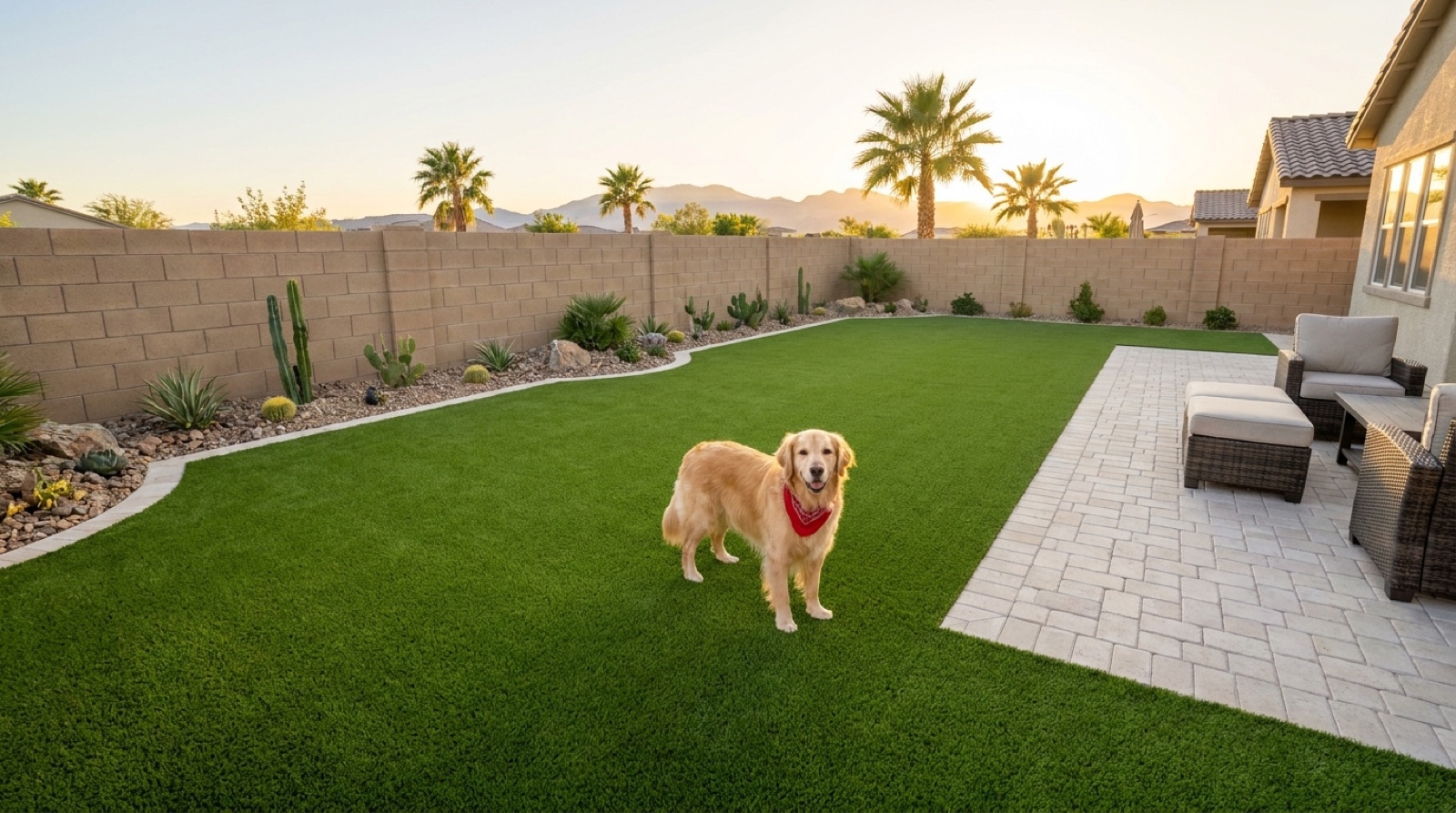
Artificial turf is one of the most popular yard choices in the Las Vegas Valley, and for good reason. It stays green year-round, survives drought restrictions, and never needs mowing. But for dog owners, turf introduces a set of waste management problems that natural grass mostly avoids. Understanding those differences is the first step to keeping your yard clean and odor-free.
Why turf hides nothing but traps everything
On natural grass, solid waste sits on a surface that breathes, drains, and eventually breaks down organically. On artificial turf, solid waste sits on top of synthetic fibers and an infill layer, usually crumb rubber or silica sand. The good news: solid waste is easy to spot and easy to scoop. Nothing hides it.
The problem is everything beneath the surface. Liquid waste, urine in particular, soaks down through the fibers and into the infill material, then into the backing, and in some installations into the base layer underneath. That infill holds moisture and organic material. Bacteria and odor compounds settle in where a hose cannot reach them. The surface dries quickly in the Nevada heat, but the infill stays damp and warm longer than it appears from above. That trapped moisture is where the smell comes from.
Turf does not clean itself
Natural lawns have some built-in biological processes working in their favor. Soil microbes break down organic material over time. Rain carries some residue away. None of that applies to artificial turf. There is no biological breakdown happening in a synthetic fiber or a rubber crumb. Waste that soaks into the infill stays there until something removes it.
A common assumption among turf owners is that rain or sprinkler rinses do the same job they would on natural grass. They do not. Water dilutes the surface layer, but it does not disinfect, and it does not reach bacteria embedded in the infill. The yard can look and feel clean an hour after a rinse while the odor compounds are still present at the base level.
How Las Vegas heat makes turf odor worse
Artificial turf in a desert climate absorbs and holds heat differently than natural grass. On a 105-degree June afternoon, turf surface temperatures in direct sun can be significantly higher than the air temperature. That heat accelerates bacterial activity and bakes odor compounds into the infill faster than you would see in a cooler or more humid climate.
This is why a turf yard that seems manageable in February can smell noticeably worse by the time May arrives, even with the same cleanup schedule. The biology has not changed. The temperature has. We cover this dynamic in more detail in our post on dog poop and summer heat in Las Vegas, and it applies to turf yards even more directly than it does to grass yards.
Scooping and sanitizing are two different things
This distinction matters for turf owners more than anyone else. Scooping removes solid waste from the surface. That is the starting point, and it needs to happen on a consistent schedule. But scooping alone does not address the bacterial load that has accumulated in the infill over weeks or months of liquid waste. A yard that is scooped regularly but never sanitized will still develop a persistent underlying odor, especially during warmer months.
Sanitizing means applying a pet-safe disinfecting treatment to the turf surface and infill to kill bacteria at a level that rinsing cannot reach. This is the step that actually resets the odor baseline. Our yard deodorizing and sanitizing service uses the Wysiwash system, a concentrated hypochlorous acid formula that is effective against bacteria and safe for pets once it dries. More detail on how that system works is in our Wysiwash post.
How often turf yards need service
The right schedule depends on how many dogs use the yard and how hot the season is. Here is a general guide:
| Dogs using the turf | Recommended scoop cadence | Recommended sanitizing cadence |
|---|---|---|
| 1 dog, smaller yard | Weekly | Monthly |
| 1 to 2 dogs, typical yard | Weekly | Bi-weekly in summer, monthly off-season |
| 2 to 3 dogs, any yard | Weekly or bi-weekly | Bi-weekly year-round |
| 3 or more dogs | Twice weekly | Bi-weekly or more frequent |
| Commercial, HOA, dog run | Daily or twice weekly | Weekly |
During the hottest months, May through September, bump your scoop cadence up one tier and add sanitizing if you are not already on it. The heat will outpace a schedule that worked fine in winter. For more detail on matching your cadence to your yard type, see our post on how often to pick up dog poop in Las Vegas.
What PSD does differently on turf yards
We scoop turf yards the same way we scoop grass yards: a full perimeter-to-perimeter sweep on every visit, not just the obvious spots, because on turf the surface is uniform and it is easy to miss waste tucked near fence posts or shaded edges. Waste is double-bagged and placed in your trash bin at the end of every visit. You also get photo proof so you can see the yard status without being home.
For turf sanitizing, we offer the Wysiwash add-on as part of a recurring plan. The treatment is applied after scooping so the surface is clear before any product touches it. Sanitizing is available monthly at approximately $60 per month, or bi-weekly at approximately $85 per month. If you are in Summerlin or elsewhere in the Valley and your yard has seen warmer-weather buildup, that bi-weekly cadence makes the most practical difference. Summerlin yards in particular tend to run hotter on the turf surface due to the open sun exposure in newer subdivisions, so we see higher demand for the add-on service there.
A note on starting fresh with a neglected turf yard
If the yard has not been scooped in more than two weeks, a standard visit is not the right starting point. An initial cleanup gives us the time needed to do a thorough first pass across the entire surface, including edges and shaded spots that accumulate the most buildup. That first visit costs $120 when paired with a recurring plan. After that, your regular schedule keeps the yard at a manageable baseline. If you need a one-time clean with no recurring commitment, that is available at $170.
Starting fresh also gives the sanitizing treatment the best possible result, because we are applying it to a surface that has been fully cleared rather than one with residue still present. The two steps work together, not independently.
The bottom line for Las Vegas turf owners
Artificial turf is genuinely low-maintenance for most yard tasks. Pet waste is the one area where it requires more attention than natural grass, not less. The combination of a consistent scoop schedule and periodic sanitizing keeps the odor compounds from building up in the infill, which is the source of the smell that a hose alone cannot fix. If your yard has reached the point where you can smell it before you open the back door, the infill needs more than scooping. If you are staying ahead of it on a regular cadence, it stays manageable year-round.
Get a quote to see exact pricing for your yard. We will ask for your zip code, dog count, and whether you want sanitizing added on, and you will have a number in about 60 seconds.
Back to the blog